
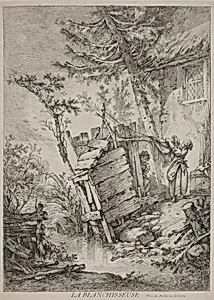
La Blanchisseuse
1756
Medium
etching on laid paper
Dimensions
sheet: 31.2 x 22.4 cm (12 5/16 x 8 13/16 in.) mount: 41.2 x 31.6 cm (16 1/4 x 12 7/16 in.)
Classification
Department
CG-E
Museum
National Gallery of Art, Washington, D.C.
Credit
Phillips Family Fund
Accession Number
2009.81.1
Rights
Public Domain
Art Historical Context
**La Blanchisseuse ( Washerwoman), 1756** Françoisoucher, a leading figure of the French Rococo movement, created *La Blanchisseuse* as an etching on laid paper, a technique that allowed him to capture intricate details with fluid, expressive lines. Measuring 31.2 x 22.4 cm on its sheet, this print exemplifies Boucher's versatility beyond his famed paintings, showcasing his skill in translating the Rococo's playful elegance into reproductive art. Rococo, flourishing in mid-18th-century France under Louis XV, emphasized lightness, ornamentation, and scenes of everyday grace, often infused with sensuality. As court painter and designer, Boucher drew from genre subjects like the washerwoman to evoke a romanticized view of labor, blending realism with fantasy. Etching on laid paper—distinguished by its textured chain lines—facilitated precise tonal effects and widespread distribution, making high art accessible. This work reflects the era's cultural shift toward intimate domesticity amid aristocratic excess. Acquired through the Phillips Family Fund for the National Gallery of Art's prints collection (CG-E), *La Blanchisseuse* invites visitors to appreciate how Boucher democratized Rococo charm, influencing fashion, porcelain, and tapestry design across Europe. A delightful glimpse into 18th-century refinement! (198 words)
About the Artist
François Boucher · 1703–1770
François Boucher (1703–1770) stands as the quintessential master of French Rococo painting and the most celebrated decorative artist of the 18th century. Born in Paris to a lace designer, Boucher created a visual language that perfectly embodied the refined taste, sensuality, and elegance of Louis XV's court. His prolific output—encompassing paintings, tapestry designs, theatrical sets, and decora...