
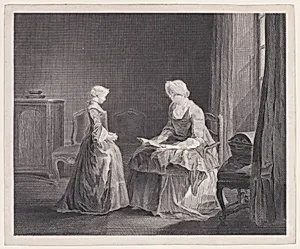
La Bonne Education
Medium
Engraving; before first state of two (Bocher)
Dimensions
Sheet (trimmed): 10 7/8 × 13 1/8 in. (27.6 × 33.3 cm)
Classification
Prints
Department
Drawings and Prints
Museum
Metropolitan Museum of Art, New York, NY
Credit
The Elisha Whittelsey Collection, The Elisha Whittelsey Fund, 1963
Accession Number
63.622.5
Rights
Public Domain
Tags
Art Historical Context
"La Bonne Education," an engraving dated 1749 by Jacques Philippe Le Bas after a composition by Jean Siméon Chardin, offers a glimpse into 18th-century French domestic life. Chardin, celebrated for his sensitive genre scenes of ordinary households, favored quiet moments that revealed moral virtues rather than dramatic narratives. Le Bas’s skilled reproductive engraving, issued before the first of two states, translated the painter’s subtle handling of light and texture into a medium that reached wider audiences. The image centers on women and girls gathered with books in an intimate interior, directly evoking the title’s theme of proper upbringing. Such subjects mirrored Enlightenment-era interest in education, especially the role of mothers and governesses in shaping young minds within the home. The engraving’s modest scale—roughly 11 by 13 inches—makes the scene feel personal and accessible. Acquired by the Metropolitan Museum through the Elisha Whittelsey Fund, this print highlights how reproductive engravings helped spread Chardin’s restrained, humane vision across Europe, turning private moments of learning into shared cultural ideals.
About the Artist
Jean Siméon Chardin|Jacques Philippe Le Bas · 1699–1779
Jean-Baptiste-Siméon Chardin, born on November 2, 1699, in Paris to a cabinetmaker father who crafted billiard tables, grew up immersed in the city's artisan world on the Left Bank near Saint-Sulpice. His early training came through apprenticeships with the history painters Pierre-Jacques Cazes, where he honed academic drawing techniques, and Noël-Nicolas Coypel, whose assignment to copy a musket ...