
La Caffarella (ou Grotte d'Egerie)
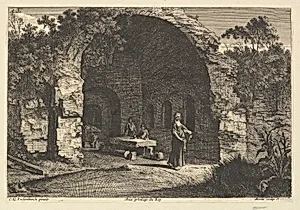
Medium
Etching, third state
Dimensions
image: 5 11/16 x 8 5/16 in. (14.4 x 21.1 cm)
Classification
Prints
Department
Drawings and Prints
Museum
Metropolitan Museum of Art, New York, NY
Credit
The Elisha Whittelsey Collection, The Elisha Whittelsey Fund, 1951
Accession Number
51.501.6744
Rights
Public Domain
Tags
Art Historical Context
Discover *La Caffarella (ou Grotte d'Egerie)*, a captivating 17-century etching by French engraver Jean Morin after artist Cornelis van Poelenburch Created between 1620 and 1650, this third-state print measures 5 11/16 x 8 5/16 inches and depicts the ancient Grotte d'Egerie in Rome's Caffarella valley—a site linked to the nymph Egeria, to King Numa. Poelenburch, a pioneer of Italianate landscapes in the Dutch Golden Age, infused the scene with elegant figures of men and women amid lush ruins, evoking classical antiquity. Etching allowed Morin to capture Poelenburch's delicate details with intricate linework, a technique prized for its precision and tonal depth in reproductive prints. The "third state" indicates refinements like added shading or burr, enhancing atmospheric effects typical of the era's printmaking innovations. Housed in the Metropolitan Museum of Art's Drawings and Prints department (The Elisha Whittelsey Collection, 1951), this work reflects the 17th-century fascination with Roman heritage and mythology, bridging Northern European artistry with Italy's enduring legacy. A window into how prints democratized access to grand landscapes for collectors far from Rome.
About the Artist
Jean Morin|Cornelis van Poelenburch · 1605–1650
Jean Morin (c. 1605–1650) was one of the most accomplished French engravers of the seventeenth century, a master of the portrait print whose work stands among the finest examples of French graphic art in its era. Little is known about his early life or training, though his technique suggests exposure to both French and Flemish engraving traditions, the latter being the dominant force in European p...