
La Chiesa, Borgio
1926
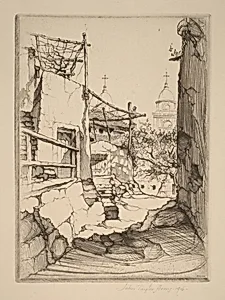
Medium
etching on laid paper
Dimensions
plate: 15.88 x 11.43 cm (6 1/4 x 4 1/2 in.) sheet: 24.77 x 18.1 cm (9 3/4 x 7 1/8 in.)
Classification
Department
CG-W
Museum
National Gallery of Art, Washington, D.C.
Credit
Gift of David F. Wright
Accession Number
2009.71.4
Rights
Public Domain
Art Historical Context
**La Chiesa, Borgio***John Taylor Arms, 1926* Etching on laid paper; plate: 15.88 × 11.43 cm (6¼ × 4½ in.); sheet: 24.77 × 18.1 cm (9¾ × 7⅛ in.) National Gallery of Art, Washington, Gift of David F. WrightJohn Taylor Arms, a leading American etcher of the early 20th century, captured the timeless charm of European architecture in *La Chiesa, Borgio* (1926). Depicting a quaint church in the Italian coastal village of Borgio Verezzi, this intimate print reflects Arms' passion for Gothic and Romanesque structures during his extensive travels. Created in the interwar period, when American artists eagerly documented Old World treasures, the work embodies the etching revival—a movement celebrating fine printmaking as an accessible art form. Arms mastered the etching technique, incising intricate lines into a metal plate with acid to produce rich, velvety textures and precise architectural details. Printed on laid paper, which reveals subtle chain lines from its handmade origins, the piece highlights the medium's ability to convey depth and atmosphere in a compact format. His meticulous style, often likened to engraving, invites viewers to linger on shadowed arches and weathered stone. Housed in the National Gallery of Art's print collection, this gift from David F. Wright exemplifies Arms' enduring influence. For visitors, it offers a window into Italy's rustic spirituality, reminding us how a small etching can evoke the grandeur of history.
About the Artist
John Taylor Arms · 1887–1953
John Taylor Arms (1887–1953) was one of America's foremost etchers of the twentieth century, renowned for his meticulous renderings of Gothic architecture. Born in Washington, D.C., he initially pursued law at Princeton University before transferring to the Massachusetts Institute of Technology, where he earned a master's degree in architecture in 1912. He apprenticed as a draftsman and worked for...