
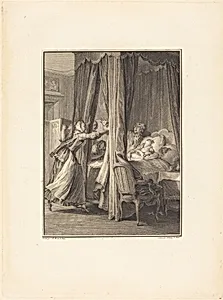
Mort de Julie
1726 to 1750
Medium
etching and engraving
Classification
Department
CG-E
Museum
National Gallery of Art, Washington, D.C.
Credit
Widener Collection
Accession Number
1942.9.2496
Rights
Public Domain
Art Historical Context
**Mort de Julie** is a poignant 18th-century print created by Robert Delaunay after a design by Jean-Michel Moreau, dating from 1726 to 1750. Housed in the National Gallery of Art's Widener Collection (Department CG-E), this etching and engraving exemplifies the reproductive printmaking techniques that made intricate artwork accessible to a broader audience during the French Rococo and early Neoclassical periods. Moreau, a renowned illustrator known for his detailed book engravings and theatrical scenes, provided the original composition, while Delaunay's skilled execution captured its emotional depth. The medium—etching, where acid etches lines into a metal plate, combined with direct engraving for fine details—allowed for rich tonal contrasts and expressive shading. This hybrid technique was vital in the 18th century for producing high-quality prints that rivaled paintings in drama and precision, often illustrating literary or historical tragedies. "Mort de Julie" ("Death of Julie") likely depicts a dramatic moment of loss, reflecting the era's fascination with sentiment, morality, and human emotion in art. As part of the Widener Collection, this work highlights the popularity of such prints among collectors, bridging elite patronage and public appreciation. Visitors will appreciate its technical mastery and evocative storytelling, a window into Enlightenment-era sensibilities.