
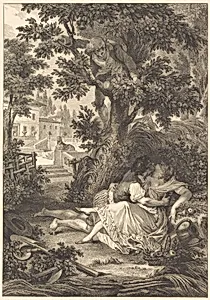
La gageure des trois commeres: Le poirier
1651 to 1700
Medium
etching and engraving
Classification
Department
CG-E
Museum
National Gallery of Art, Washington, D.C.
Credit
Rosenwald Collection
Accession Number
1953.6.175
Rights
Public Domain
Art Historical Context
**La gageure des trois comm: Le poirier** is a lively 17th-century print after the designs of French artist Jean-Baptiste Mallet (c. 1650–1714), a master of genre scenes capturing the humor and everyday antics of ordinary folk. Produced between 1651 and 1700, the title translates to "Theager of the Three Goss: The Pear Tree,"oking a playful French proverb about three chatty women who bet on a comical challenge involving a fruit tree. Mallet's style reflects the vibrant genre tradition of the period, blending satire with vivid depictions of rural life during Louis XIV's reign, when such scenes offered lighthearted escapism amid grandeur. This work is an etching and engraving, techniques that revolutionized printmaking in the Baroque era. Etching allowed for spontaneous, expressive lines mimicking drawing, while engraving added precise detail and tonal depth, making affordable reproductions of paintings widely accessible to collectors and the middle class. Housed in the National Gallery of Art's Rosenwald Collection (Department CG-E), it exemplifies how prints democratized art, preserving Mallet's whimsical narratives for generations. Culturally, the piece highlights 17th-century fascination with proverbs and human folly, inviting viewers to chuckle at timeless gossip and rivalry. A delightful window into pre-Rococo humor, it reminds us how art captured the spirited chaos of village life. (198 words)