
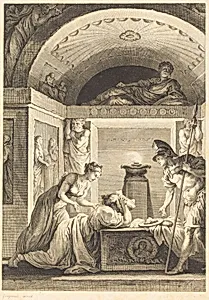
La matrone d'Ephese
Medium
etching and engraving
Classification
Department
CG-E
Museum
National Gallery of Art, Washington, D.C.
Credit
Rosenwald Collection
Accession Number
1953.6.214
Rights
Public Domain
Art Historical Context
**La Matrone d'Éphèse** is a captivating 1793 etching and engraving by Jean-Louis Delignon and-Jean Duclos, faithfully reproducing a composition by the renowned Rococo master Jean-Honoré Fragonard. Housed in the National Gallery of Art's Rosen Collection (Department CG-E), this print captures Fragonard's signature playful sensuality, drawing from the ancient tale in Petronius' *Satyricon* of a devoted widow from Ephesus whose grief is tenderly interrupted by a soldier's affections. Fragonard's original paintings on this theme, created in the 1770s, exemplify late Rococo's exuberant eroticism and lighthearted exploration of human desire amid classical motifs. The medium of etching and engraving allowed for exquisite detail and tonal subtlety, making Fragonard's lavish brushwork accessible to a wider audience through affordable prints. Produced during the French Revolution's turbulent year of 1793, it reflects a lingering aristocratic taste just as revolutionary ideals reshaped society. These techniques—etching for fluid lines and engraving for precise shading—highlight the collaborative skill of Delignon and Duclos in translating painting into enduring reproductive art. This work invites visitors to ponder timeless themes of love, loss, and temptation, bridging 18th-century frivolity with enduring classical storytelling. A gem for print enthusiasts, it showcases how printmaking preserved Rococo's charm for future generations.