
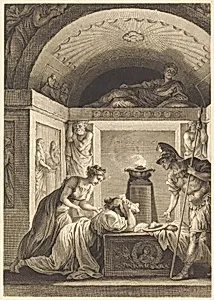
La matrone d'Ephese
Medium
etching and engraving
Classification
Department
CG-E
Museum
National Gallery of Art, Washington, D.C.
Credit
Rosenwald Collection
Accession Number
1953.6.215
Rights
Public Domain
Art Historical Context
**La Matrone d'Éphèse** is a captivating print from 1793, created byavers Jean-Louis Delignon and Antoine-Jean Duclos after an original composition by the renowned Rococo master Jean-Honoré Frard. This etching and engraving depicts a scene from the ancient Roman tale in Petronius' *Satyricon*, where virtuous widow of Ephesus, overcome by grief, is tenderly consoled—and ultimately seduced—by a steadfast soldier guarding crucified bodies nearby. Fragonard's playful, sensual style infuses the image with Rococo elegance: swirling drapery, soft lighting, and expressive gestures that blend pathos with subtle eroticism. Produced during the turbulent French Revolution, the print reflects the enduring popularity of Fragonard's libertine themes even as neoclassicism rose to prominence. Etching allowed for the fluid, spontaneous lines mimicking Fragonard's brushwork, while engraving added precise tonal depth and intricate details, making fine art accessible through affordable reproductions. Housed in the National Gallery of Art's Rosenwald Collection (Department CG-E), it exemplifies 18th-century printmaking's role in disseminating elite imagery to a broader audience. This work invites visitors to ponder timeless human desires amid historical upheaval, showcasing how Rococo frivolity persisted as a counterpoint to revolutionary austerity. A delightful glimpse into Enlightenment-era wit! (198 words)