
La Mosquée d'Omar, à Jérusalem
August 20, 1850
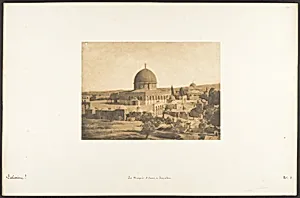
Medium
Salted paper print from paper negative
Dimensions
Image: 6 11/16 × 9 1/4 in. (17 × 23.5 cm) Mount: 12 5/16 × 18 11/16 in. (31.2 × 47.5 cm) Frame: 16 x 20 in. (40.6 x 50.8 cm)
Classification
Photographs
Department
Photographs
Museum
Metropolitan Museum of Art, New York, NY
Credit
Gilman Collection, Gift of The Howard Gilman Foundation, 2005
Accession Number
2005.100.376.172
Rights
Public Domain
Tags
Art Historical Context
Step into the golden hues of Jerusalem's sacred landscape with *La Mosquée d'Omar, à Jérusalem*, a salted paper print captured by Maxime Camp on August 20 1850. This evocative photograph depicts the iconic Dome of the Rock, known as the Mosque of Omar, a masterpiece of Islamic architecture completed in the late 7th century. Du Camp, a pioneering French and traveler, documented the Middle East during an expedition that same year, bringing distant wonders to Western eyes through his lens. Printed from a paper negative—a hallmark of the calotype process invented by William Henry Fox Talbot—this medium was revolutionary in 1850. Unlike the unique daguerreotype, the paper negative allowed for multiple prints, making Du Camp's images more accessible. The subtle tonalities and soft details of salted paper evoke a dreamlike quality, faithfully rendering the mosque's intricate domes, arches, and tiles while hinting at the challenges of early outdoor photography, such as long exposures under the Middle Eastern sun. Housed in the Metropolitan Museum of Art's Gilman Collection, this 6 11/16 × 9 1/4 in. image holds immense historical value as one of the earliest surviving photographs of this UNESCO World Heritage site. It bridges 19th-century exploration with timeless cultural reverence, inviting visitors to ponder the Dome's role as a symbol of faith across Judaism, Christianity, and Islam.
About the Artist
Maxime Du Camp · 1822–present
Maxime Du Camp (1822–1894) was a pioneering French photographer and writer whose adventurous spirit and technical innovation bridged literature and visual art during the mid-19th century. Born in Paris on February 8, 1822, to a prosperous family—his father a successful surgeon—Du Camp received a solid bourgeois education at the Collège Bourbon (now Lycée Condorcet), where he cultivated interests i...