
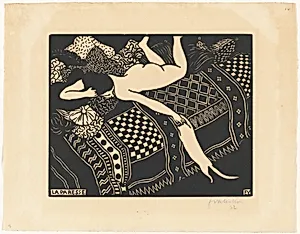
La paresse (Laziness)
1896
Medium
woodcut on cream wove paper
Dimensions
image: 17.9 x 22.4 cm (7 1/16 x 8 13/16 in.) sheet: 25 x 32.1 cm (9 13/16 x 12 5/8 in.)
Classification
Department
CG-E
Museum
National Gallery of Art, Washington, D.C.
Credit
Gift of Frank and Jeannette Eyerly
Accession Number
1986.81.1
Rights
Public Domain
Art Historical Context
Félix Vallotton’s 1896 woodcut *La paresse (aziness)* captures the indulgence of its title the artist’s distinctive graphic style. A Swiss-born and printmaker closely associated with the Nabis group, Vallotton helped revive woodcut as a modern artistic medium at the turn of the twentieth century. Working on cream wove paper, he exploited the technique’s bold contrasts and simplified forms to distill a scene into essential lines and shapes, reflecting both Japanese ukiyo-e influences and the decorative spirit of the 1890s. The print’s modest scale—roughly seven by nine inches for the image—belies its expressive power. Vallotton’s economical carving removes all but the most telling details, allowing the viewer’s eye to linger on the languid pose that embodies the theme. As a work on paper rather than a unique painting, *La paresse* participated in the era’s growing interest in affordable, widely distributable art that could reach new audiences beyond the traditional salon. Today housed in the National Gallery of Art as a gift of Frank and Jeannette Eyerly, the woodcut stands as a fine example of Vallotton’s ability to merge intimate subject matter with striking formal clarity. Its crisp black-and-white design continues to reward close looking, revealing how restraint and suggestion can convey both mood and modern sensibility.
About the Artist
Félix Vallotton · 1865–1925
Félix Vallotton (1865–1925) was born in Lausanne, Switzerland, into a comfortable middle-class family, and moved to Paris in 1882 to enroll at the Académie Julian, where he studied under the portrait painter Jules Joseph Lefebvre and the history painter Gustave Boulanger. Paris would remain his home for the rest of his life, and he became a French citizen in 1900 following his marriage to the art ...