
La Parisienne (11)
1902
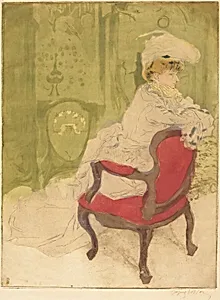
Medium
color softground etching, drypoint, aquatint, and embossing on wove paper
Dimensions
plate: 45 x 33.9 cm (17 11/16 x 13 3/8 in.) sheet: 60.5 x 49.1 cm (23 13/16 x 19 5/16 in.)
Classification
Department
CG-W
Museum
National Gallery of Art, Washington, D.C.
Credit
Gift of Evelyn Stefansson Nef
Accession Number
1999.53.1
Rights
Public Domain
Art Historical Context
Jacques Villon's *La Parisienne (11, created in 1902, the elegance of Parisian life during the Belle Époque. Villon, a pioneering French printmaker and brother to artists Marcel Duchamp and Raymondamp-Villon, was for his innovative color prints that celebrated urban sophistication. This work likely depicts a stylish Parisian woman, embodying the fashionable allure of fin-de-siècle France, where posters and prints became vibrant mediums for modern culture. The artwork showcases Villon's mastery of complex intaglio techniques: color softground etching for fluid lines mimicking pencil sketches, drypoint for rich, velvety textures from burr lines, aquatint for subtle tonal gradations, and embossing for tactile dimensionality—all on wove paper. At 45 x 33.9 cm (plate), this print exemplifies early 20th-century experimentation with color in printmaking, bridging Impressionist vibrancy and emerging modernist abstraction. Now in the National Gallery of Art's collection (gift of Evelyn Stefansson Nef), *La Parisienne (11)* highlights Villon's role in elevating prints as fine art, inviting viewers to savor the tactile beauty and cultural glamour of Paris at the dawn of a transformative era.
About the Artist
Jacques Villon · 1875–1963
Jacques Villon, born Gaston Émile Duchamp on July 31, 1875, in Damville, Normandy, hailed from a family brimming with artistic talent. As the eldest of six children, he grew up alongside his brothers Raymond Duchamp-Villon, a pioneering sculptor, and Marcel Duchamp, the renowned Dadaist, as well as his sister Suzanne Duchamp, also a painter. Their maternal grandfather, Émile Frédéric Nicolle, a pr...