
La Porte dorée à Jérusalem
August 1850
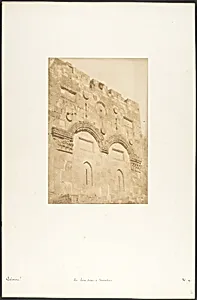
Medium
Salted paper print from paper negative
Dimensions
Image: 9 5/16 × 6 3/8 in. (23.7 × 16.2 cm) Mount: 12 5/16 × 18 11/16 in. (31.2 × 47.5 cm)
Classification
Photographs
Department
Photographs
Museum
Metropolitan Museum of Art, New York, NY
Credit
Gilman Collection, Gift of The Howard Gilman Foundation, 2005
Accession Number
2005.100.376.173
Rights
Public Domain
Tags
Art Historical Context
Step through time with *La Porte dorée à Jér* (The Golden Gate at Jerusalem), a captivating salted paper print captured by Maxime Du Camp in August1850. This 9 5/16 × 6 3/8-inch image depicts the iconic Golden Gate, a sealed eastern entrance to Jerusalem's Old City walls, revered in Jewish, Christian, and Muslim traditions a prophesied portal for the Messiah. Du Camp, a pioneering French photographer and writer, documented this ancient architectural marvel during his groundbreaking 1849–1850 expedition through Egypt and the Holy Land alongside Gustave Flaubert. As one of the earliest surviving photographs of the site, the work holds immense historical value, offering a rare mid-19th-century glimpse of the Middle East before mass tourism. Du Camp's use of the calotype process—exposing a paper negative to produce a salted paper positive—yielded soft, textured tones that evoke the gate's weathered stone and dramatic shadows, blending artistry with scientific precision in an era when photography was still experimental. Housed in The Metropolitan Museum of Art's Gilman Collection (gift of The Howard Gilman Foundation, 2005), this print exemplifies early travel photography's role in bridging East and West, preserving sacred architecture for global audiences.
About the Artist
Maxime Du Camp · 1822–present
Maxime Du Camp (1822–1894) was a pioneering French photographer and writer whose adventurous spirit and technical innovation bridged literature and visual art during the mid-19th century. Born in Paris on February 8, 1822, to a prosperous family—his father a successful surgeon—Du Camp received a solid bourgeois education at the Collège Bourbon (now Lycée Condorcet), where he cultivated interests i...