
La Toilette
1890–94
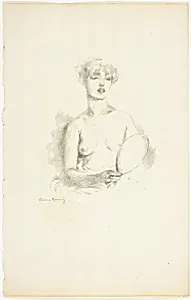
Medium
Transfer lithograph in black on cream laid paper
Dimensions
Image: 16 × 13 cm (6 5/16 × 5 1/8 in.); Sheet: 31.8 × 20.2 cm (12 9/16 × 8 in.)
Classification
lithograph
Department
Prints and Drawings
Museum
Art Institute of Chicago
Accession Number
211082
Rights
Public Domain
Art Historical Context
Theodore Roussel’s “La Toilette,” created between 1890 and 1894, exemplifies the refined printmaking practices of late nineteenth-century Britain. As a transfer lithograph printed in black on cream laid paper, the work demonstrates a technique that allowed artists to draw directly onto specially prepared paper before transferring the image to a lithographic stone. This method provided greater freedom and fluidity than working directly on stone, enabling the delicate lines and subtle tonal variations visible in the compact 16-by-13-centimeter image. Roussel, known for his contributions to the etching revival and his experiments with lithography, used the medium to explore intimate, everyday subjects. The title suggests a private dressing scene, a motif popular in the period for its quiet domesticity and modern sensibility. Printed on a sheet roughly twice the size of the image, the work balances careful composition with the spontaneous quality lithography afforded. Today housed in the Prints and Drawings collection at the Art Institute of Chicago, “La Toilette” reflects lithography’s growing acceptance as a fine-art medium capable of reaching wider audiences while maintaining artistic sophistication. Its modest scale and elegant execution invite close looking, revealing the tactile charm of the printed line on laid paper.
About the Artist
Theodore Roussel · 1847–1926
Theodore Casimir Roussel was born on 23 March 1847 in Lorient, Brittany, France, into a naval family. After serving in the Franco-Prussian War, he began painting in 1872 as an entirely self-taught artist, initially rendering scenes of daily life in the meticulous style of the Old Masters. In 1878, he settled permanently in London, where he immersed himself in the vibrant British art scene. There, ...