
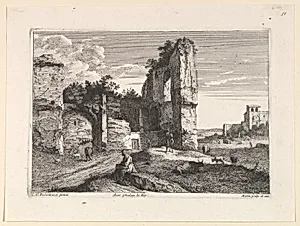
La Vieille Femme Assise
Medium
Etching, first state
Dimensions
sheet: 7 5/16 x 9 9/16 in. (18.5 x 24.3 cm) image: 5 11/16 x 8 3/16 in. (14.5 x 20.8 cm)
Classification
Prints
Department
Drawings and Prints
Museum
Metropolitan Museum of Art, New York, NY
Credit
Harris Brisbane Dick Fund, 1945
Accession Number
45.35.13
Rights
Public Domain
Tags
Art Historical Context
**La Vieille Femme AssiseThe Old Woman Seated)** This evocative etching, created by French engraver Jean Morin after design by Dutch painter Cornelis van Poelenurch, captures a poignant of everyday life amid classical ruins. Dated unknown but likely from the early 17th century, it belongs to the first state—an early, pristine impression prized by collectors for its crisp lines before later revisions. Measuring about 7 x 9 inches on the sheet, the intimate image (5 11/16 x 8 3/16 inches) draws viewers into a world blending human figures, animals, and weathered architecture, evoking the pastoral idylls popular in Northern European art. Poelenburch, a pioneer of Dutch Italianate landscape painting, infused his works with idealized ruins inspired by his Roman travels, symbolizing the passage of time. Morin’s masterful etching technique translates this with fine cross-hatching for texture and depth, highlighting the old woman’s contemplative pose against a backdrop of decay and companionship from animals. As a reproductive print, it made Poelenburch’s compositions accessible to a wider audience, bridging painting and printmaking during the Dutch Golden Age. Acquired through the Harris Brisbane Dick Fund in 1945, this Metropolitan Museum of Art treasure exemplifies the era’s fascination with vanitas themes—mortality amid beauty—and the technical brilliance of etching as a democratic medium for sharing artistic visions. A quiet gem for print enthusiasts! (198 words)
About the Artist
Jean Morin|Cornelis van Poelenburch · 1605–1650
Jean Morin (c. 1605–1650) was one of the most accomplished French engravers of the seventeenth century, a master of the portrait print whose work stands among the finest examples of French graphic art in its era. Little is known about his early life or training, though his technique suggests exposure to both French and Flemish engraving traditions, the latter being the dominant force in European p...