
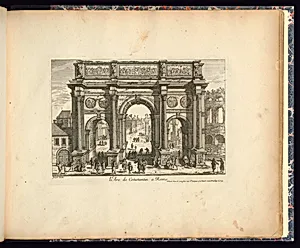
L’Arc de Constantin a Rome
late 17th century
Classification
Department
Smithsonian Collection
Museum
Smithsonian American Art Museum
Credit
Purchased for the Museum by the Advisory Council
Accession Number
1921-6-533-237
Rights
Public Domain
About this artwork
Research in Progress
Art Historical Context
Gabriel Perelle's *L’Arc de Constantin à Rome*, a late 17th-century print, captures one of ancient Rome's most iconic landmarks: the Arch of Constantine. Erected between 312 and 315 CE to celebrate Emperor Constantine I's victory over Maxent at the Battle of the Milvian Bridge—a moment tied to his conversion to Christianity triumphal arch stands as a masterpiece of Roman imperial architecture. Adorned with reliefs earlier emperors and intricate sculptures, it symbolizes the grandeur of the Eternal City, drawing admirers during the era of the Grand Tour. Perelle, a prolific French engraver (1604–1677), specialized in precise topographical views of European architecture, blending meticulous detail with a sense of scale that brought distant wonders to life. As a print, this work reflects the 17th-century boom in reproductive prints, making classical antiquities accessible to collectors and scholars across Europe. Though the exact medium remains under study, Perelle's technique likely employed etching or engraving to evoke the arch's weathered stones and bustling Roman forum surroundings. Housed in the Smithsonian American Art Museum's collection—purchased by the Advisory Council—this piece bridges European printmaking traditions with American curatorial interests, inviting visitors to ponder Rome's enduring legacy through a French lens. Research continues to uncover more about its creation, enriching our appreciation of 17th-century artistry.