
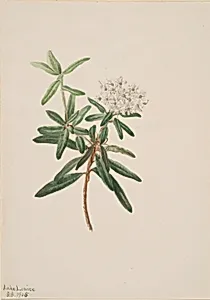
Labrador Tea (Ledum groenlandicum)
Medium
Painting
Classification
Painting
Department
Smithsonian Collection
Museum
Smithsonian American Art Museum
Credit
Smithsonian American Art Museum, Gift of the artist
Accession Number
1970.355.201
Rights
Public Domain
Tags
Art Historical Context
Mary Vaux Walcott'sLabrador Tea (Led groenlandicum)*, in 1905, the delicate beauty of this evergreen shrub native to North America's wetlands. A pioneering artist and naturalist1860–1940), Walcott created meticulously detailed botanical illustrations during her summer expeditions in the Rocky Mountains. Gifted by the artist to the Smithsonian American Art, this work exemplifies her dual passion for art and science, blending aesthetic grace with scientific precision. Walcott's paintings, primarily in watercolor, belong to the tradition of 19th- and early 20th-century botanical art, where accuracy served both decorative and educational purposes. Her series, later published in the seminal book *North American Wild Flowers* (1925) with the Smithsonian Institution, documented over a thousand species, aiding botanists while showcasing her masterful technique in rendering translucent petals, fine veins, and subtle color gradients. Labrador tea, with its clusters of white flowers and aromatic leaves once used in herbal remedies, is rendered here with lifelike clarity. This piece highlights women's contributions to American natural history at a time when fieldwork was male-dominated. Displayed in the Smithsonian's collection, it invites visitors to appreciate nature's intricacies through Walcott's enduring legacy.