
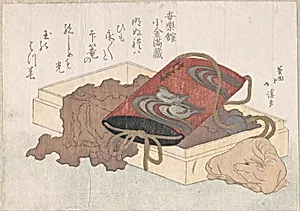
印籠と牛根付『春雨集』 摺物帖|Lacquer Inrō with Waterbirds and Ox-shaped Netsuke in a BoxFrom the Spring Rain Collection (Harusame shū), vol. 3
probably 1817
Medium
Part of an album of woodblock prints (surimono); ink and color on paper
Dimensions
5 1/4 x 7 3/8 in. (13.3 x 18.7 cm)
Classification
Prints
Culture & Period
Japan · Edo period (1615–1868)
Department
Asian Art
Museum
Metropolitan Museum of Art, New York, NY
Credit
H. O. Havemeyer Collection, Bequest of Mrs. H. O. Havemeyer, 1929
Accession Number
JP2350
Rights
Public Domain
Tags
Art Historical Context
Behold this exquisite woodblock print by Totoya Hokkei, leading ukiyo-e artist pupil of the famed Katsushika Hokusai, created around 1817 during Japan's Edo period (1615–1868). Titled *Lacquer Inrō Waterbirds and Ox-shapeduke in a Box* the *Spring Rain Collection* (Harame shū), volume3, it measures a intimate 5¼ x 7⅜ inches and is part of a luxurious surimono album—privately commissioned prints often exchanged as New Year's gifts among poetry lovers. The composition delicately captures a lacquered inrō, a portable medicine case worn suspended from the sash, adorned with graceful waterbirds, alongside an ox-shaped netsuke—a carved toggle that secured it. Hokkei's masterful use of ink and color on paper showcases ukiyo-e techniques like subtle gradations (bokashi) and metallic pigments, evoking the sheen of lacquer and the whimsy of everyday objects elevated to art. Surimono like this were printed in small editions on fine paper, blending poetry, nature, and craftsmanship. Housed in the Metropolitan Museum of Art's Asian Art collection (H. O. Havemeyer Bequest, 1929), this print reflects Edo Japan's vibrant merchant culture, where functional items like inrō and netsuke became symbols of refined taste. It invites us to appreciate the period's fusion of utility, humor, and beauty in miniature form.
About the Artist
Totoya Hokkei · 1780–1850
Totoya Hokkei (魚屋 北渓, 1780–1850), born Iwakubo Tatsuyuki in Edo (modern Tokyo), began his life as a humble fishmonger in the Yotsuya Samegahashi district, a trade reflected in his art name "Totoya," meaning fish shop. He transitioned to art through rigorous training, first studying under Kanō Yōsen'in Korenobu, head of the Kobikichō branch of the prestigious Kanō school, where he honed landscape p...