
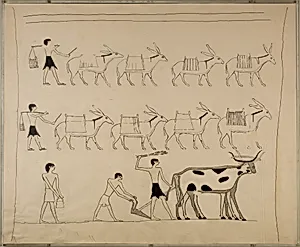
Laden Donkeys and Men Plowing, Tomb of Djari
ca. 2050–2000 B.C.
Medium
Ink on Paper
Dimensions
h. 56 cm (22 1/16 in); w. 68 cm (26 3/4 in) - as mounted, scale 1:3, framed: h. 57.8 cm (22 3/4 in); w. 69.5 cm (27 3/8 in)
Classification
Facsimile, Djari (TT 366), plowing, donkeys
Period
First Intermediate Period–Middle Kingdom
Department
Egyptian Art
Museum
Metropolitan Museum of Art, New York, NY
Credit
Rogers Fund, 1931
Accession Number
INST.1979.2.9
Rights
Public Domain
Tags
Art Historical Context
This ink-on-paper facsimile captures a lively agricultural scene from the Tomb of Djari, created during Egypt’s Dynasty 11 (ca. 2050–2000 B.C.). Dating to the close of the First Intermediate Period and the dawn of Middle Kingdom, the original wall painting belonged to a time when local rulers in Thebes were consolidating power and reestablishing centralized authority after decades of political fragmentation. The composition shows men guiding plows while laden donkeys transport goods, themes that vividly illustrate the rhythms of farming life. In ancient Egyptian tombs, such everyday activities were not merely decorative; they were believed to magically sustain the deceased in the afterlife, ensuring a continuous supply of food and labor. Acquired by the Metropolitan Museum in 1931, this scaled reproduction (1:3) preserves the original’s energetic line work and allows visitors to study the tomb’s imagery without traveling to the site itself. As a modern copy, it bridges the gap between an ancient monument and today’s audiences, highlighting the enduring appeal of Egyptian art’s celebration of work and abundance.