
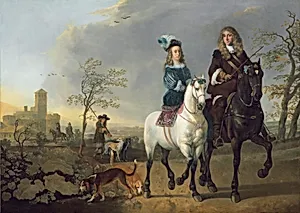
Lady and Gentleman on Horseback
c. 1655, reworked 1660/1665
Medium
oil on canvas
Dimensions
overall: 123 x 172 cm (48 7/16 x 67 11/16 in.) framed: 164.8 x 214 x 16.2 cm (64 7/8 x 84 1/4 x 6 3/8 in.)
Classification
Painting
Department
CNE-B
Museum
National Gallery of Art, Washington, D.C.
Credit
Widener Collection
Accession Number
1942.9.15
Rights
Public Domain
Art Historical Context
Aelbert Cuyp’s *Lady and Gentleman on Horseback* captures a moment of quiet elegance from the mid-seventeenth century. Painted in oil on canvas around 1655 and later reworked by the artist, the large-scale work (nearly four feet high) presents two figures astride finely groomed horses against a luminous landscape. The medium’s rich tonal range allowed Cuyp to render the sheen of satin riding habits, the glint of harness buckles, and the soft haze of distant hills with remarkable subtlety. Created during the Dutch Republic’s prosperous Golden Age, such equestrian portraits celebrated the leisure and status of the emerging merchant class. Cuyp, celebrated for his Italianate light effects, transformed an ordinary outing into a scene of harmony between humans, animals, and nature. The later reworking suggests the artist continued to refine the balance of light and composition, underscoring his meticulous approach. Today in the National Gallery of Art’s Widener Collection, the painting invites viewers to appreciate both the technical mastery of Dutch seventeenth-century oil technique and the enduring appeal of an afternoon ride bathed in golden sunlight.
About the Artist
Aelbert Cuyp · 1620–1691
Aelbert Cuyp (1620–1691), a leading figure of the Dutch Golden Age, was born and died in Dordrecht, Netherlands, where he spent his entire life. The son of portraitist and animal painter Jacob Gerritsz Cuyp (1594–1652), Aelbert came from a family of artists—his uncle Benjamin Gerritsz Cuyp and grandfather Gerrit Gerritsz Cuyp were stained-glass designers—and studied under his father, with whom he ...