
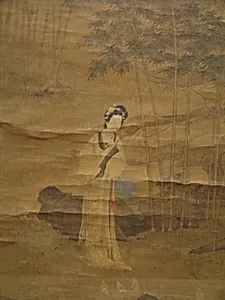
明 沈碩 仿仇英文玉圖 軸|Lady in a Bamboo Grove after Qiu Ying
Medium
Hanging scroll; ink and color on silk
Dimensions
Image: 46 1/2 × 19 1/2 in. (118.1 × 49.5 cm) Overall with mounting: 9 ft. 4 in. × 27 5/8 in. (284.5 × 70.2 cm) Overall with knobs: 9 ft. 4 in. × 31 3/4 in. (284.5 × 80.6 cm)
Classification
Paintings
Culture & Period
China · Ming dynasty (1368–1644)
Department
Asian Art
Museum
Metropolitan Museum of Art, New York, NY
Credit
Gift of John C. Ferguson, 1916
Accession Number
16.151
Rights
Public Domain
Tags
Art Historical Context
This exquisite hanging scroll, *Lady in a Bamboo Grove Qiu Ying*, was created by the Ming dynasty artist Shen Sh during the period of 1368–1644. Rendered in ink and color on silk—a luxurious medium prized for its smooth surface that allows for delicate layering and vibrant hues—the painting measures an impressive 46½ × 19½ inches. It depicts a graceful woman amid swaying bamboo stalks, evoking refined elegance of classical Chinese literati art. Donated to the Metropolitan Museum of Art in 1916 by John C. Ferguson, it now graces the Asian Art department. Shen Shuo's work is a faithful imitation ("fang") of a composition by the renowned Ming master Qiu Ying (ca. 1490–1552), a leading figure of the Wu school from Suzhou. Qiu was celebrated for his meticulous gongbi technique—fine, precise brushstrokes that capture intricate details in figures, flora, and architecture—blending Southern Song academism with professional finesse. By emulating Qiu, Shen Shuo paid homage to this tradition, showcasing the Ming era's reverence for copying esteemed predecessors to hone skills and preserve cultural heritage. Bamboo, a staple in Chinese painting, symbolizes resilience and integrity, while the solitary lady in a serene grove reflects ideals of feminine virtue and scholarly retreat. Hanging scrolls like this were unrolled for contemplation in elite studios, fostering meditative appreciation. This piece offers visitors a window into Ming China's artistic sophistication and enduring aesthetic values.