
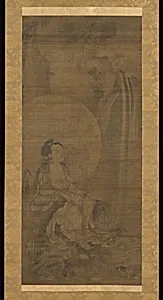
白衣観音図|White-robed Kannon
Unknown Artist
14th century
Medium
Hanging scroll; ink on silk
Dimensions
Image: 45 3/4 × 20 3/8 in. (116.2 × 51.8 cm) Overall with mounting: 82 3/4 × 26 1/4 in. (210.2 × 66.7 cm) Overall with knobs: 82 3/4 × 28 5/8 in. (210.2 × 72.7 cm)
Classification
Paintings
Culture & Period
Japan · Nanbokuchō period (1336–92)
Department
Asian Art
Museum
Metropolitan Museum of Art, New York, NY
Credit
Purchase, Bequest of Dorothy Graham Bennett, Herbert J. Coyne Gift, Seymour Fund and Fletcher Fund, by exchange, 1985
Accession Number
1985.120.2
Rights
Public Domain
Tags
Art Historical Context
This exquisite hanging scroll, *White-robed Kannon hails from Japan's Nanbokuchō period (133692), a turbulent era civil war between rival imperial courts. Created by an unknown artist in the 14th century using ink on silk, it portrays Kannon (Avalokiteshvara the bodhisattva of compassion, draped in flowing white robes that symbolize purity and grace. Surrounded by cascading waterfalls, the figure evokes a sense of serene divinity amid nature's power, a common motif in Buddhist art to convey enlightenment and mercy. Ink on silk was a revered medium in Japanese painting, allowing for subtle gradations, fluid lines, and misty washes that bring spiritual depth. Hanging scrolls like this were unrolled for meditation or rituals in temples and homes, making sacred imagery accessible. The minimalist composition highlights Kannon's gentle expression and dynamic robes, blending Zen influences with esoteric Buddhism popular during this time. Housed in the Metropolitan Museum of Art's Asian Art collection, this work captures Japan's devotion to Kannon, whose cult promised protection and healing. Its survival through centuries underscores the enduring cultural reverence for bodhisattvas as compassionate guides in an uncertain world.