
Lady in the Rain
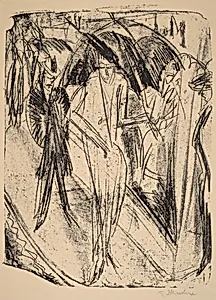
Medium
lithograph printed in black
Dimensions
image: 42.3 x 31.6 cm (16 5/8 x 12 7/16 in.) sheet: 50 x 38.6 cm (19 11/16 x 15 3/16 in.)
Classification
Department
CG-W
Museum
National Gallery of Art, Washington, D.C.
Credit
Gift of Ruth Cole Kainen
Accession Number
2012.92.73
Rights
Public Domain
Art Historical Context
**Lady in the Rain** (1914) is a striking lithograph by Ernst Ludwig Kirchner, a pioneering German Expressionist and co-founder of the Die Br group. Created on the eve of World War, this black-and-white print captures the raw energy of urban life in early 20th-century Germany Kirchner, known for his bold distortions and emotional intensity, often depicted city streets teeming with modernity's alienation, and this image of a solitary woman braving the rain evokes the isolation amid bustling crowds—a hallmark of Expressionist response to industrialization and social upheaval. Printed in black ink on a modest sheet (50 x 38.6 cm), the lithograph showcases Kirchner's mastery of the medium. Lithography, a planographic process using greasy crayons on stone or metal, allowed for rich tonal contrasts and fluid lines, enabling the artist to produce multiple impressions with expressive spontaneity. The image measures 42.3 x 31.6 cm, its stark contrasts amplifying the dramatic play of light and shadow on rain-slicked surfaces. Housed in the National Gallery of Art's Department of Modern Prints (CG-W) as a gift from Ruth Cole Kainen, this work exemplifies Kirchner's innovative printmaking, bridging fine art and graphic reproduction. Visitors will appreciate its timeless portrayal of human resilience in the face of life's storms, a poignant snapshot from a turbulent era.
About the Artist
Ernst Ludwig Kirchner · 1880–1938
Ernst Ludwig Kirchner was born on May 6, 1880, in Aschaffenburg, Germany, to parents Ernst and Maria Kirchner, part of a family of Prussian descent that frequently relocated due to his father's career as a chemical technician. After early schooling in various towns, he studied architecture at the Königliche Technische Hochschule (Technical University) in Dresden from 1901 to 1905, taking courses i...