
Lady's head
ca. 1755
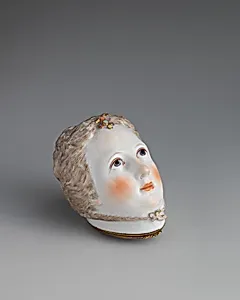
Medium
Soft-paste porcelain
Dimensions
Overall: 2 7/8 × 3 1/2 in. (7.3 × 8.9 cm)
Classification
Ceramics-Porcelain
Culture
British, Chelsea
Department
European Sculpture and Decorative Arts
Museum
Metropolitan Museum of Art, New York, NY
Credit
Gift of Irwin Untermyer, 1964
Accession Number
64.101.663
Rights
Public Domain
Tags
Art Historical Context
Step into the elegant world of 18th British porcelain with *Lady's Head*, a delicate creation from the Chelsea Porcelain Manufactory 1755. This small soft-paste porcelain bust, measuring just 2 7/8 × 3 1/2 inches, captures the refined features of a woman in exquisite detail. Produced in Chelsea, London, during the factory's renowned "gold anchor" period, it exemplifies the height of British ceramic artistry amid Europe's porcelain mania. Chelsea Manufactory, one of England's earliest porcelain producers (active 1743–ca. 1770), mastered soft-paste porcelain—a friable yet luminous material blending clay with ground glass and soapstone, fired at lower temperatures than true Chinese hard-paste. This technique allowed for intricate modeling and vibrant enameling, making pieces like this lady's head prized collector's items for fashionable homes. Often displayed on mantelpieces or tables, these figurines reflected rococo tastes with their graceful forms and implied period attire. Today, housed in the Metropolitan Museum of Art's European Sculpture and Decorative Arts collection (gift of Irwin Untermyer, 1964), *Lady's Head* highlights Chelsea's innovation in rivaling Meissen and Sèvres. Its cultural charm lies in embodying the era's blend of luxury, technical prowess, and whimsy— a tiny testament to Britain's golden age of ceramics.
About the Artist
Chelsea Porcelain Manufactory · 1744–1784
**Chelsea Porcelain Manufactory** The Chelsea Porcelain Manufactory, Britain's pioneering porcelain enterprise, was founded around 1743 in Chelsea, London, by two Huguenot silversmiths: Nicholas Sprimont from Liège and Charles Gouyn. Sprimont, trained in Paris as a goldsmith before immigrating to England, brought his expertise in luxury metalwork to the venture, while Gouyn handled early sales th...