
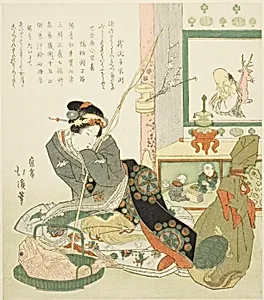
Lady Seated by a Tokonoma Alcove
1829
Medium
Color woodblock print; surimono
Dimensions
20.9 × 18.2 cm (8 1/4 × 7 3/16 in.)
Classification
woodblock print
Department
Arts of Asia
Museum
Art Institute of Chicago
Accession Number
23583
Rights
Public Domain
Art Historical Context
In the intimate world of 19th-century Japan, Totoya Hokkei's *Lady Seated by aonoma Alcove* (1829) captures a of refined elegance. Hokkei, a skilled ukiyo-e print and pupil of the legendary Katsushikaokusai, specialized in depicting bijin—beautiful women—in everyday yet poetic settings. Created during the late Edo period, this wood print reflects the era's fascination with domestic tranquility and aesthetic harmony, where the tokonoma alcove served as a room's spiritual focal point for displaying scrolls, flowers, or ceramics. As a surimono, this color woodblock print stands out for its luxurious production. Unlike mass-market ukiyo-e, surimono were privately commissioned, often for New Year's greetings or poetry clubs, featuring deluxe techniques like embossing, mica dusting, and vibrant pigments on a compact 20.9 × 18.2 cm format. This format allowed for exquisite detail, emphasizing the lady's graceful pose and the alcove's subtle opulence, inviting viewers to savor Japan's cultural emphasis on wabi-sabi imperfection and seasonal beauty. Housed in the Art Institute of Chicago's Arts of Asia collection, Hokkei's work exemplifies how surimono bridged art and social ritual, preserving ephemeral moments with enduring artistry. A delightful glimpse into Edo-era refinement!
About the Artist
Totoya Hokkei · 1780–1850
Totoya Hokkei (魚屋 北渓, 1780–1850), born Iwakubo Tatsuyuki in Edo (modern Tokyo), began his life as a humble fishmonger in the Yotsuya Samegahashi district, a trade reflected in his art name "Totoya," meaning fish shop. He transitioned to art through rigorous training, first studying under Kanō Yōsen'in Korenobu, head of the Kobikichō branch of the prestigious Kanō school, where he honed landscape p...