
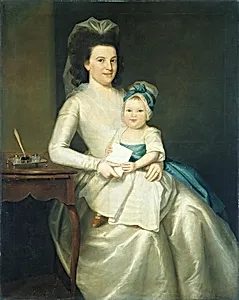
Lady Williams and Child
1783
Medium
Oil on canvas
Dimensions
50 1/4 x 39 3/4 in. (127.3 x 101 cm)
Classification
Painting
Culture
American
Department
The American Wing
Museum
Metropolitan Museum of Art, New York, NY
Credit
Rogers Fund, 1906
Accession Number
06.179
Rights
Public Domain
Tags
Art Historical Context
Ralph Earl’s *Lady Williams and Child* (1783) captures a tender moment between mother and infant in the refined tradition of late-eighteenth-century portraiture. Painted in oil on canvas, the work reflects the formal British style Earl absorbed during his studies in London before returning to the newly independent United States. The generous scale—over four feet tall—signals the sitter’s social standing and the importance of family lineage in the years following the American Revolution. Earl’s careful attention to fabric textures and the gentle positioning of the child on Lady Williams’s lap conveys both affection and dignity, typical of portraits meant to celebrate domestic virtue. Created just as the Treaty of Paris confirmed American independence, the painting offers a glimpse into the private world of elite families navigating a changing political landscape. Today in the Metropolitan Museum’s American Wing, the canvas reminds visitors how portraiture served not only as a record of likeness but also as a statement of stability and hope for the young nation.
About the Artist
Ralph Earl · 1751–1801
Ralph Earl (1751–1801) was born on May 11 in Shrewsbury or Leicester, Massachusetts, the eldest of four children to Ralph Earle, a colonel in the Revolutionary army, and Phebe Whittemore Earl. Growing up amid farmers and craftsmen in Worcester County, Earl displayed prodigious talent as a self-taught artist, emulating the works of John Singleton Copley after observing his half-brother Henry Pelham...