
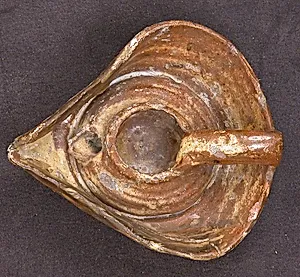
Lamp
Unknown Artist
7th–11th century
Medium
Earthenware; unglazed
Dimensions
H. 1 1/2 in. (3.8 cm) W. 3 in. (7.6 cm) L. 3-1/2 in. (8.9 cm)
Classification
Ceramics
Department
Islamic Art
Museum
Metropolitan Museum of Art, New York, NY
Credit
Gift of Miriam Schaar Schloessinger, 1964
Accession Number
64.207.5
Rights
Public Domain
Art Historical Context
This modest earthenware lamp, dating from the 7th to 11th century, hails from the early Islamic world during the Umayyad and Abbasid periods. Crafted from unglazed clay, it measures just 1 1/2 inches high and about 3 1/2 inches long, making it a compact, portable source of light for homes, mosques, or travelers. Such lamps were essential for daily life, typically filled with oil and fitted with a wick, illuminating the rapid cultural and technological expansions of the Islamic Golden Age. The unglazed earthenware technique reflects practical artistry: fired at low temperatures for durability without the expense or fragility of glazing. Hand-formed or mold-pressed, these vessels prioritized function over ornamentation, embodying the Islamic emphasis on humility in utilitarian objects. Common across regions from the Levant to Persia, they offer a glimpse into everyday routines amid flourishing trade and scholarship. Today, this lamp graces the Metropolitan Museum of Art's Islamic Art collection, a 1964 gift from Miriam Schaar Schloessinger. It reminds us how simple ceramics preserve the pulse of history, bridging ancient hearths to modern museums.