
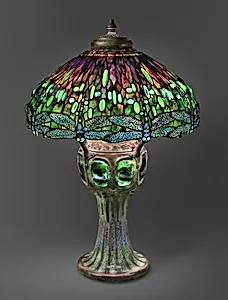
Lamp with “Hanging Head Dragonfly” Shade and “Mosaic and Turtleback” Base
By 1906
Medium
Favrile glass and bronze
Dimensions
86.4 × 57.2 cm (34 × 22 1/2 in.)
Classification
lamp (lighting device)
Department
Arts of the Americas
Museum
Art Institute of Chicago
Accession Number
185905
Rights
Public Domain
About this artwork
In the 1890s Louis Comfort Tiffany began using his opalescent Favrile glass to produce lamps, the decorative form for which he would become most famous. As the artistic director of Tiffany Studios located in Corona, New York, he approved all patterns but created relatively few lamps himself. Clara Driscoll, head of the Women’s Glass Cutting Department, was likely responsible for this shade and base. Driscoll began working for Tiffany in 1888, and she designed the majority of the firm’s lamps bef...
Art Historical Context
Clara Driscoll's *Lamp with “Hanging Dragonfly” Shade andMosaic and Turtleback Base* (by 1906) exemplifies luminous artistry of Tiffany Studios during the height of the Art Nouveau movement As a pioneering female designer and head of the Women's Glass Cutting Department at Tiffany New York workshops, Driscoll crafted this stunning table lamp from Favrile glass—a signature iridescent material invented by Louis Comfort Tiffany—and patinated bronze. Standing at 86.4 × 57.2 cm, its shade features meticulously leaded glass dragonfly motifs with dangling heads that evoke a sense of ethereal movement, while the base combines mosaic tiles and textured "turtleback" glass for added depth and glow. The lamp's historical significance lies in its fusion of nature-inspired design and innovative glass techniques, hallmarks of early 20th-century American decorative arts. Driscoll's intricate patterns, assembled from hundreds of hand-cut glass pieces, transform ordinary light into a mesmerizing display of color and texture, reflecting the era's fascination with organic forms and Japonisme influences. Produced during Tiffany's golden age, such lamps were luxury items for Gilded Age homes, symbolizing technological prowess in glassmaking. Today, housed in the Art Institute of Chicago's Arts of the Americas collection, this piece highlights Driscoll's underrecognized contributions—rediscovered through her rediscovered letters—offering visitors a window into the collaborative genius behind Tiffany's iconic lighting legacy.