
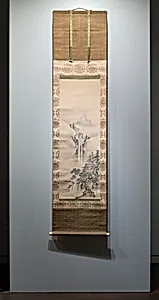
Landsape with Waterfall
Late 17th–early 18th century
Medium
Triptych of hanging scrolls; ink and light colors on silk
Dimensions
Painting: 94.3 × 32.4 cm (37 1/8 × 12 3/4 in.); 177.8 × 42.6 cm (with mounting) (70 × 16 3/4 in.);177.8 × 46.7 cm (with knobs) (70 × 18 3/8 in.)
Classification
hanging scroll
Department
Arts of Asia
Museum
Art Institute of Chicago
Accession Number
17956
Rights
Public Domain
Art Historical Context
Behold *Landscape with Waterfall*, a captivating triptych of hanging scrolls by Kanô Tsunenobu, a master of Japan's esteemed Kanô school during the late 17th to early 18th century. Crafted in ink and light colors on silk, each scroll measures about 94 cm high, forming a harmonious vertical panorama when displayed together. This Edo-period work, now housed in the Art Institute of Chicago's Arts of Asia department, exemplifies the school's professional painters, who served samurai elites and shoguns with their refined techniques. The Kanô style blended bold ink brushwork with subtle color washes, drawing from Chinese literati traditions while emphasizing Japan's love for nature's sublime power. Tsunenobu's cascading waterfall dominates the composition, evoking the dynamic energy of mountains and mist—hallmarks of suiboku-ga (ink painting) adapted for grandeur. Hanging scrolls like these were unrolled for special occasions, transforming rooms into immersive scenes that invited contemplation. Culturally, such landscapes reflected Zen-inspired ideals of impermanence and harmony with the environment, bridging art and spirituality in feudal Japan. Measuring up to 178 cm with ornate mountings, this triptych invites visitors to trace the fluid lines and misty veils, feeling the rush of ancient waters.