
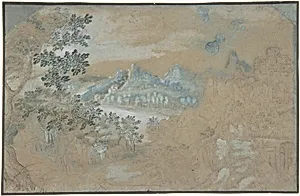
Landscape
late 16th, early 17th century
Medium
Pen and brown ink, with green and blue watercolor, heightened with bodycolor
Dimensions
12 11/16 x 14 3/16 in. (32.2 x 36 cm)
Classification
Drawings
Department
Drawings and Prints
Museum
Metropolitan Museum of Art, New York, NY
Credit
Gift of Cornelius Vanderbilt, 1880
Accession Number
80.3.442
Rights
Public Domain
Tags
Art Historical Context
This delicate landscape drawing, attributed to either Paul Bril or Gill van Coninxloo—or possibly their collaborative circle—captures the lush, imaginative vistas of late 16th- to early 17th-century Flanders. Created during the heyday of Antwerp's artistic scene, when landscape emerged as a standalone genre, it exemplifies the Northern European fascination with nature's grandeur amid religious and political upheavals like the Dutch Revolt. Executed in pen and brown ink green and blue watercolor, with bodycolor (opaque white pigment), the work showcases virtuoso techniques for evoking depth and atmosphere. Fine ink lines delineate towering trees, rolling hills, and distant buildings, while subtle washes add vibrancy and luminosity—methods that bridged preparatory sketches and finished compositions. Van Coninxloo pioneered dense, vertical woodland scenes, influencing a generation, while Bril's Roman sojourn infused his landscapes with idealized, atmospheric effects. A generous gift from Cornelius Vanderbilt in 1880, this 12⅝ × 14¼-inch sheet (32.2 × 36 cm) at the Metropolitan Museum of Art highlights the era's shift toward naturalistic detail, inviting viewers to wander its timeless terrain. (198 words)