
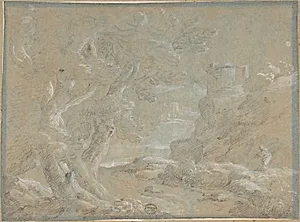
Landscape
Medium
Black chalk, highlighted with white gouache on blue paper, faded to blue-brown
Dimensions
7-9/16 x 10-1/4 in. (19.2 x 26 cm)
Classification
Drawings
Department
Drawings and Prints
Museum
Metropolitan Museum of Art, New York, NY
Credit
Gift of Cornelius Vanderbilt, 1880
Accession Number
80.3.394
Rights
Public Domain
Tags
Art Historical Context
This exquisite 17th-century landscape drawing, attributed to an anonymous artist from the Roman-Bolog school, captures the rugged beauty of the Italian countryside with trees dominating the composition. Created using black chalk heightened with white gouache on paper—now faded to a subtle blue-brown—the work exemplifies the preparatory sketches prized by Baroque-era artists. At 7-9/16 x 10-1/4 inches, its intimate scale invites close contemplation, revealing masterful use of light and shadow to evoke depth and atmosphere. The Roman-Bolognese style blends the dramatic grandeur of Roman landscapes with Bologna's refined naturalism, influenced by masters like the Carracci family and Domenichino. Such drawings were often studies for larger oil paintings or standalone works, showcasing the era's fascination with *veduta*—topographical views that celebrated Italy's terrain amid the Counter-Reformation's emphasis on divine creation in nature. The technique of colored paper with white highlights allowed artists to simulate the luminosity of finished canvases efficiently. A generous gift from Cornelius Vanderbilt in 1880, this piece now resides in the Metropolitan Museum of Art's Drawings and Prints department. It offers visitors a window into 17th-century draftsmanship, where everyday scenery became a canvas for artistic innovation and poetic observation.