
Landscape
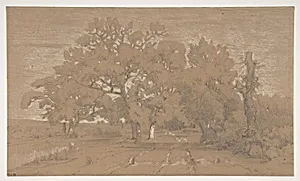
Medium
Graphite, heightened with white chalk, on brown paper
Dimensions
6 5/16 x 10 11/16 in. (16 x 27.1 cm)
Classification
Drawings
Department
Drawings and Prints
Museum
Metropolitan Museum of Art, New York, NY
Credit
Pfeiffer Fund, 1964
Accession Number
64.136.2
Rights
Public Domain
Tags
Art Historical Context
Théodore Rousseau's *Landscape* (1842) captures the essence of the French countryside through a masterful drawing that exemplifies his pivotal role in the Barbizon. Active in the 1830s and 1840s around the Fontainebleau Forest, Rousseau the idealized landscapes of academic art, favoring direct observation of nature's raw beauty. This intimate study, rendered on brown paper, likely served as a preparatory sketch for larger oil paintings, reflecting his commitment to plein air sketching amid trees and rolling terrain—hallmarks of his oeuvre. Executed in graphite heightened with white chalk, the work showcases Rousseau's innovative mixed-media technique. The brown support provides a warm, earthy base, while graphite builds depth in foliage and shadows, and white chalk highlights catch sunlight on leaves and branches. At just 6 5/16 x 10 11/16 inches, its compact scale invites close inspection, revealing the textured interplay of light that foreshadowed Impressionism. Acquired by The Metropolitan Museum of Art via the Pfeiffer Fund in 1964, this drawing offers visitors a window into Rousseau's process, blending Romantic reverence for nature with proto-modern realism. It's a testament to how 19th-century artists like him shifted focus from myth to the everyday sublime of the natural world.
About the Artist
Théodore Rousseau · 1812–1867
Théodore Rousseau (1812–1867) was a French landscape painter and the leading figure of the Barbizon School, the group of artists who settled in the village of Barbizon near the Forest of Fontainebleau to paint directly from nature. Born in Paris, he showed precocious talent and studied under the academic painters Charles Rémond and Guillaume Guillon-Lethière, but quickly rejected classical landsca...