
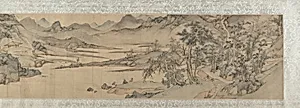
明 佚名 傳文伯仁 山水圖 卷|Landscape
dated 1558
Medium
Handscroll; ink and color on paper
Dimensions
Image: 7 1/16 × 48 1/2 in. (17.9 × 123.2 cm) Overall with mounting: 9 9/16 in. × 10 ft. 11 1/2 in. (24.3 × 334 cm)
Classification
Paintings
Culture & Period
China · Ming (1368–1644)–Qing (1644–1911) dynasty
Department
Asian Art
Museum
Metropolitan Museum of Art, New York, NY
Credit
John Stewart Kennedy Fund, 1913
Accession Number
13.220.98
Rights
Public Domain
Tags
Art Historical Context
This exquisite handscroll, attributed to the Ming dynasty artist Wen Boren and dated 1558, exemplifies the refined tradition of Chinese landscape painting during a period of cultural flourishing. Wen Boren, a member of the esteemed Wu School of painters centered in Suzhou, drew inspiration from earlier masters while developing his own delicate approach to natural scenery. Created in ink and color on paper, the compact format of the handscroll—measuring just over seven inches in height—invites intimate viewing, as audiences would unroll it section by section to journey through misty mountains and winding paths. In the Ming era, such works held deep significance within scholar-official circles, serving not only as aesthetic expressions but also as meditations on harmony between humanity and nature. The painting’s subtle layering of washes and fine brushwork reflects the literati emphasis on capturing the spirit of the landscape rather than mere topography. Acquired by the Metropolitan Museum of Art in 1913, this piece offers modern visitors a window into centuries-old artistic practices that valued contemplation and poetic resonance over dramatic realism.
About the Artist
Wen Boren · 1502–1575
Renowned Ming Wu School painter whose landscapes reflect the tradition of Shen Zhou and the mountain landscapes of Wang Meng. Wen Boren’s training from Wen Zhengming is evidenced by his use of dry textures. All of his paintings bear inscriptions by Dong Qichang.