
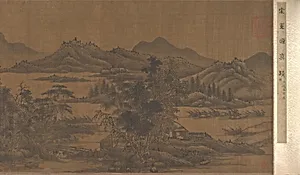
明/清 佚名 舊傳董源 山水圖 卷|Landscape
17th century
Medium
Handscroll; ink on silk
Dimensions
15 3/8 in. × 23 ft. 6 1/2 in. (39.1 × 717.6 cm)
Classification
Paintings
Culture & Period
China · Ming (1368–1644) or Qing (1644–1911) dynasty
Department
Asian Art
Museum
Metropolitan Museum of Art, New York, NY
Credit
John Stewart Kennedy Fund, 1913
Accession Number
13.100.28
Rights
Public Domain
Tags
Art Historical Context
This exquisite handscroll, titled *Landscape* (Shanshui tu juan), is a masterful ink painting on silk from the 17th century, during China's Ming (1368–1644) or Qing (1644–1911) dynasty. Measuring a modest 15⅜ inches in height but an impressive 23 feet 6½ inches in length, it exemplifies the traditional Chinese handscroll format, designed for intimate, sequential viewing—unrolled gradually across a table to reveal unfolding vistas of mist-shrouded mountains, winding rivers, and thatched pavilions. Long attributed to the legendary 10th-century artist Dong Yuan, a pioneer of monumental ink landscapes from the Jiangnan region, it is now recognized as the work of an unidentified master emulating his style. Dong Yuan's influence looms large here, with fluid brushstrokes evoking the "poetic" or "pipa" method—short, hemp-fiber-like lines that capture the rugged texture of cliffs and the softness of foliage. This technique, rooted in the Tang-Song transition, became a cornerstone of literati painting, blending Daoist harmony with nature. Created amid the refined tastes of late imperial collectors, the scroll reflects shanshui (mountain-and-water) ideals, where landscapes symbolize moral retreat and spiritual contemplation. Acquired by the Metropolitan Museum of Art in 1913 through the John Stewart Kennedy Fund, this work invites visitors to ponder the timeless allure of Chinese landscape art: a portable portal to infinity, where ink alone conjures boundless realms. (198 words)