
Landscape
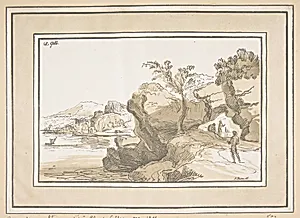
Medium
Lithograph
Dimensions
sheet: 7 5/16 x 10 1/4 in. (18.6 x 26 cm) plate: 6 7/8 x 9 3/4 in. (17.5 x 24.8 cm)
Classification
Prints
Department
Drawings and Prints
Museum
Metropolitan Museum of Art, New York, NY
Credit
Purchase, The Elisha Whittelsey Collection, The Elisha Whittelsey Fund, 1960
Accession Number
60.620.123
Rights
Public Domain
Tags
Art Historical Context
This enchanting lithograph, titled *Landscape* and dated around 1811, bridges the golden age of 17th-century landscape painting with the innovative printmaking of the early 19th century. features the masterful vision of Claude LorrainClaude Gellée), French Baroque artist renowned for his luminous, idealized seascapes and pastoral scenes infused with classical mythology and poetic light. Here, German lithographer Johann Nepom Strixner faithfully reproduces Lorrain's, capturing the delicate interplay of atmosphere, foliage, and distant horizons that defined the artist's influential style. Lithography, a groundbreaking technique invented just over a decade earlier, allowed Strixner to translate Lorrain's oil paintings or drawings onto stone with remarkable fidelity and tonal subtlety—qualities evident in this modest yet evocative print (plate: 6 7/8 x 9 3/4 in.). As part of Munich's early lithographic efforts to disseminate old master works, it democratized access to high art, making Lorrain's serene visions available to a wider audience during the Romantic era's fascination with nature and the sublime. Acquired in 1960 through The Elisha Whittelsey Fund and now housed in the Metropolitan Museum of Art's Drawings and Prints department, this piece exemplifies how printmaking preserved and popularized landscape traditions, inviting viewers to lose themselves in timeless pastoral beauty.
About the Artist
Claude Lorrain (Claude Gellée)|Johann Nepomuk Strixner · 1604–1682
Claude Gellée was born around 1600 in the village of Chamagne in the Duchy of Lorraine, from which he would take the professional name by which history knows him: Claude Lorrain. Orphaned young, he traveled south to Rome as a teenager, eventually finding his way into the Naples workshop of Goffredo Wals before apprenticing with the Roman landscapist and fresco painter Agostino Tassi around 1622. F...