
Landscape
Medium
Etching
Dimensions
Plate: 7 1/16 × 9 11/16 in. (18 × 24.6 cm) Sheet: 7 11/16 × 10 7/8 in. (19.5 × 27.7 cm)
Classification
Prints
Department
Drawings and Prints
Museum
Metropolitan Museum of Art, New York, NY
Credit
The Elisha Whittelsey Collection, The Elisha Whittelsey Fund, 1959
Accession Number
59.500.444
Rights
Public Domain
Tags
Art Historical Context
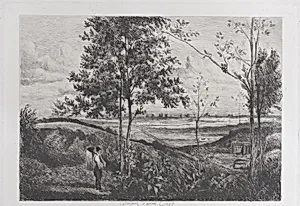
This serene *Landscape*, an etching created between 1873 and 1890, showcases a collaboration between Jean-Baptiste-Camille Corot, the esteemed French artist of the Barbizon school, and Ferdinand Lefman. Corot (1796–1875), renowned for his luminous, poetic landscapes that bridged Romanticism and Impressionism, prepared the plate in his later years, with Lefman handling the printing posthumously. The composition captures a tranquil scene of trees and figures—possibly men—evoking the quiet beauty of the French countryside, a recurring theme in Corot's oeuvre. Etching, an intaglio printmaking technique, allowed Corot to achieve delicate lines and subtle tonal gradations ideal for rendering foliage and atmospheric depth. The modest plate size (7 1/16 × 9 11/16 in.) made it accessible for collectors, democratizing fine art during the late 19th century. Housed in the Metropolitan Museum of Art's Drawings and Prints department as part of The Elisha Whittelsey Collection, this work exemplifies how prints preserved and popularized Corot's vision. Visitors will appreciate its intimate scale and evocative mood, inviting reflection on nature's enduring allure—a testament to Corot's influence on modern landscape traditions.
About the Artist
Camille Corot|Ferdinand Lefman · 1796–1875
Jean-Baptiste-Camille Corot, born in Paris on July 16, 1796, into a prosperous bourgeois family—his father a former wig maker turned draper, his mother a successful milliner—initially resisted his artistic calling. After a lackluster education at the Lycée Pierre-Corneille in Rouen and failed apprenticeships in business, he abandoned commerce at age 26, thanks to a generous parental allowance foll...