
清 佚名 高克恭(僞款) 山水圖 軸|Landscape
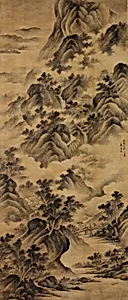
Medium
Hanging scroll; ink on silk
Dimensions
47 x 109 1/4 in. (119.4 x 277.5 cm)
Classification
Paintings
Culture & Period
China · Ming (1368–1644) or Qing dynasty (1644–1911)
Department
Asian Art
Museum
Metropolitan Museum of Art, New York, NY
Credit
Gift of Edgar Worch, in memory of his uncle, Adolphe Worch, of Paris, 1954–1955
Accession Number
54.193
Rights
Public Domain
Tags
Art Historical Context
This magnificent hanging scroll, titled *Landscape* and bearing a pseudonymous signature of the Yuan dynasty master Gao Kegong (1248–1310), is a captivating example of Chinese *shanshui* (mountains-and-waters) painting. Created by an unidentified artist during the Ming (13681644) or Qing (1644–1911) dynasty, it exemplifies the tradition of ink landscapes on silk, a medium prized for its luminous texture and ability to capture mist-shrouded vistas. At nearly 10 feet long and 4 feet high, the scroll's grand scale invites viewers to immerse themselves in towering peaks, cascading rivers, and ethereal mists, evoking the sublime harmony between humanity and nature central to Chinese artistic philosophy. Though dated unknown, the work reflects techniques honed over centuries: fluid brushstrokes in ink alone create depth through layered washes, "flying white" textures for rocky crags, and subtle dry-brush effects for distant foliage. Gao Kegong was renowned for his bold, monumental style blending Northern Song precision with Southern Song lyricism, and this piece emulates that vigor while showcasing later dynasty refinements. Hanging scrolls like this were cherished by scholar-officials, unrolled for contemplation during gatherings to inspire poetic reflection and Daoist ideals of retreat. A gift to the Metropolitan Museum of Art in 1954–1955 honoring collector Adolphe Worch, it stands as a testament to the timeless allure of Chinese landscape art, bridging imperial eras and inviting modern audiences to wander its timeless realms.
About the Artist
Gao Kegong|Unidentified artist · 1248–1310
Eldest of five sons in a family of Muslim Uygur descent. His father was a Confucian scholar who taught him the classics and prepared him for government service. Gao worked in the Yuan government in various capacities including governor and minister of justice from the age of 27. He was acquainted with painters of the period such as Zhao Mengfu and Li Zhongfang. His painting style was derived from ...