
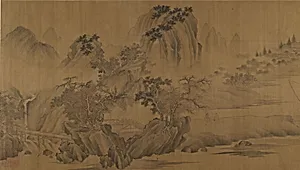
A Secluded Fishing Village
Medium
Handscroll; ink and color on silk
Dimensions
16 3/8 x 52 in. (41.6 x 132.1 cm)
Classification
Paintings
Culture & Period
China · Ming (1368–1644) or Qing (1644–1911) dynasty
Department
Asian Art
Museum
Metropolitan Museum of Art, New York, NY
Credit
H. O. Havemeyer Collection, Bequest of Mrs. H. O. Havemeyer, 1929
Accession Number
29.100.530
Rights
Public Domain
Tags
Art Historical Context
Nestled within the tranquil folds of this handscroll, *A Secluded Fishing Village transports viewers to a misty Chinese landscape of jagged mountains, quiet waters, and humble dwellings. Created with ink and color on silk during the Ming (1368–1644) or Qing (1644–1911) dynasty, the painting exemplifies the handscroll format—a cherished tradition in Chinese art. Unrolled gradually from right to left, it invites meditative journey through the scene, revealing layers of mist-shrouded peaks and a remote fishing hamlet that evokes harmony between humanity and nature. Though attributed variably to the Tang master Jing Hao or an unidentified artist, this work reflects the enduring influence of Song and Yuan landscape traditions on later painters. Ink washes masterfully suggest depth and atmosphere, while subtle colors enhance the ethereal mood, hallmarks of literati painting prized by scholars and collectors. Such depictions celebrated seclusion and natural beauty, offering spiritual respite amid dynastic upheavals. Acquired through the H. O. Havemeyer Collection and now housed in the Metropolitan Museum of Art's Asian Art department, this 16⅜ × 52-inch scroll (41.6 × 132.1 cm) captures the poetic essence of China's mountainous terrains, reminding us of art's power to preserve timeless serenity.