
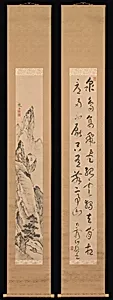
池大雅筆 「独座敬亭山」図|Landscape and Couplet of Chinese Verse
late 18th century
Medium
Pair of hanging scrolls; ink on paper
Dimensions
Each: 52 x 7 5/8 in. (132.1 x 19.4 cm)
Classification
Paintings
Culture & Period
Japan · Edo period (1615–1868)
Department
Asian Art
Museum
Metropolitan Museum of Art, New York, NY
Credit
Gift of Florence and Herbert Irving, 2015
Accession Number
2015.500.9.61a, b
Rights
Public Domain
Tags
Art Historical Context
Ike Taiga's *Landscape and Couplet of Chinese* (*池大雅筆 「独座敬亭」図*), from the late 18th century, captivates with its poetic simplicity. This pair of hanging scrolls—one featuring a misty mountain landscape, the other inscribing a couplet from Li Bai famous Tang dynasty poem "Sitting Alone Facing Mount Jing"—evokes solitude and harmony with nature. Rendered in ink on paper (each 52 x 7⅝ in.), the works exemplify the Edo-period Japanese fascination with Chinese literati ideals, blending painting and calligraphy into a meditative whole. As a leading figure in Japan's Nanga (Southern School) movement, Taiga drew inspiration from Ming-Qing Chinese masters, prioritizing expressive brushwork over photorealism. His dynamic ink washes and abbreviated strokes animate jagged peaks and swirling mists, capturing the poem's essence: a scholar finding companionship in mountains amid human isolation. This technique, known as *bunjin-ga* or literati painting, reflected the intellectual pursuits of Edo-period elites who collected such scrolls for display in alcoves (*tokonoma*). Housed in the Metropolitan Museum of Art's Asian Art Department (gift of Florence and Herbert Irving, 2015), these scrolls highlight Japan's cultural synthesis during the isolated yet culturally vibrant Edo era (1615–1868). They invite viewers to pause, much like the poet, and ponder nature's quiet wisdom.