
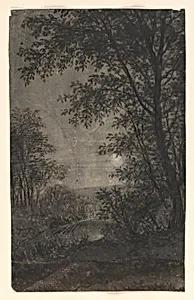
Landscape by Moonlight
ca. 1676
Medium
Black chalk and brush and black ink with gray and grayish black wash heightened with white.
Dimensions
10 3/16 x 7 1/16 in. (25.8 x 18 cm)
Classification
Drawings
Department
Robert Lehman Collection
Museum
Metropolitan Museum of Art, New York, NY
Credit
Robert Lehman Collection, 1975
Accession Number
1975.1.820
Rights
Public Domain
Tags
Art Historical Context
Anthonie Waterloo’s *Landscape by Moonlight* captures the quiet drama of nature under night skies. Created around 1676 by the Dutch artist, this drawing belongs to the rich tradition of seventeenth-century landscape that flourished in the Netherlands. Waterloo, known for his sensitive renderings of wooded scenes and atmospheric effects, used this nocturnal subject to explore light and shadow in subtle ways. The medium—black chalk combined with brush and black ink, layered gray washes, and white heightening—allows the artist to evoke the soft glow of moonlight filtering through trees. The white accents catch imagined light on foliage and ground, while the graded washes create depth and mystery in the darkened areas. This technique demonstrates Waterloo’s skill at suggesting illumination without color, turning a simple sheet of paper into a luminous nocturnal world. Housed in the Metropolitan Museum’s Robert Lehman Collection, the drawing reflects the period’s growing appreciation for nature as a subject worthy of intimate study. Its modest scale invites close looking, rewarding viewers with the tranquil mood that made moonlight landscapes enduringly popular in Dutch art.
About the Artist
Anthonie Waterloo · 1609–1690
Anthonie Waterloo (1609–1690) was a prominent Dutch Golden Age landscape artist, born on May 6 in Lille, then part of the Spanish Netherlands. Little is known of his early life beyond his mother, Magdalena Vaillant, who joined Amsterdam's Walloon Church in 1621, with Waterloo following in 1630; no records exist of formal training, and he was likely self-taught. Registered as a painter in Amsterdam...