
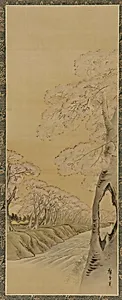
Landscape: flowering cherry trees along the banks of a stream
Classification
Painting
Department
Smithsonian Collection
Museum
Smithsonian American Art Museum
Credit
Gift of Charles Lang Freer
Accession Number
F1903.97
Rights
Public Domain
Tags
About this artwork
To 1903
Art Historical Context
This enchanting landscape, titled *Landscape: Flowering Cherry Trees Along the Banks of Stream*, is a kakemono—a traditional Japanese hanging scroll painting—created by Utagawa Hirosh II (1826–1869), a master of the ukiyo-e school. Active during the late Edo period (16151868), Hiroshige II carried forward the legacy of his teacher and uncle-by-marriage, the renowned Hiroshige I, whose depictions of nature and everyday life revolutionized Japanese printmaking. Though the exact medium remains unspecified, its classification as a painting aligns with the intimate, poetic style of ukiyo-e landscapes, emphasizing fleeting beauty. The scene captures cherry blossoms in full bloom along a serene stream, a quintessential motif in Japanese art symbolizing *mono no aware*—the pathos of things and the transience of life. These delicate pink flowers against lush greenery and flowing water evoke the hanami tradition of cherry-blossom viewing, a cultural ritual celebrating spring's ephemeral joy. Hiroshige II's technique likely employs subtle ink washes and colors to convey atmospheric depth, inviting viewers to immerse themselves in nature's quiet harmony. Acquired by collector Charles Lang Freer before 1903, this work entered the Smithsonian American Art Museum as part of his pioneering gift, highlighting early Western appreciation for Japanese art. A gem from the Edo era, it bridges artistry and philosophy, reminding us of beauty's brief dance.