
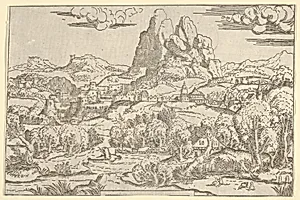
Landscape from "Venus Pushing Cupid" frame
Medium
Etching
Dimensions
Sheet (trimmed): 5 5/16 in. × 8 in. (13.5 × 20.3 cm)
Classification
Prints
Department
Drawings and Prints
Museum
Metropolitan Museum of Art, New York, NY
Credit
The Elisha Whittelsey Collection, The Elisha Whittelsey Fund, 1949
Accession Number
49.95.375
Rights
Public Domain
Tags
Art Historical Context
This delicate etching, created between 1540 and 1545, captures a tranquil landscape of rolling hills dotted with houses. Attributed to Antonio Fantuzzi after designs by Rosso Fiorentino, it likely served as a decorative frame element for a larger mythological scene titled *Venus Pushing Cupid*. The compact sheet, measuring just over five by eight inches, showcases the intimate scale often favored in Renaissance printmaking. Rosso Fiorentino, a leading figure of Italian Mannerism, brought his elegant, elongated style to the French court at Fontainebleau, where he collaborated with printmakers like Fantuzzi. These artists helped spread Mannerist motifs across Europe through reproducible etchings. The medium allowed for fine, expressive lines that beautifully render the gentle contours of the hills and architectural details, making such landscapes accessible to collectors beyond royal circles. Acquired by the Metropolitan Museum of Art in 1949 as part of the Elisha Whittelsey Collection, this print highlights the growing importance of landscape as an independent subject in 16th-century art. It offers viewers a quiet glimpse into the pastoral ideals that complemented the dramatic narratives of gods and goddesses popular at the time.
About the Artist
Antonio Fantuzzi|Rosso Fiorentino · 1537–1545
**Antonio Fantuzzi** (active 1537–1550) was an Italian painter and printmaker born in Bologna who played a significant role in the First School of Fontainebleau during the French Renaissance. He worked in a Mannerist style, contributing to the lavish decorations of the Palace of Fontainebleau under royal patronage. Fantuzzi is recorded as a painter at Fontainebleau from 1537 onward, initially on ...