
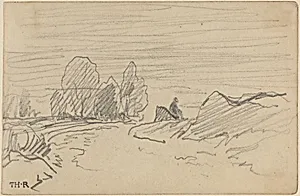
Landscape I
1801 to 1825
Medium
graphite on wove paper
Dimensions
overall: 8.5 x 12.9 cm (3 3/8 x 5 1/16 in.)
Classification
Drawing
Department
CG-E
Museum
National Gallery of Art, Washington, D.C.
Credit
Gift of William B. O'Neal, in Honor of the 50th Anniversary of the National Gallery of Art
Accession Number
1991.150.62
Rights
Public Domain
Art Historical Context
**Landscape I by Théodore Rousseau** Théodore Rousseau, a French artist born in 1812, was a central figure in the Barbizon School, which emphasized realistic depictions of nature observed directly en plein air. Created between 1801 and 1825—likely during his formative years—this intimate drawing captures the essence of Rousseau's lifelong passion for the French countryside. As one of the earliest known works by the artist, *Landscape I* reflects the Romantic era's reverence for unidealized wilderness, predating the Impressionists while laying groundwork for their outdoor sketching traditions. Rendered in graphite on wove paper, a smooth support ideal for precise shading and detail, the modest 8.5 x 12.9 cm sheet showcases Rousseau's masterful use of line and tone to evoke depth and atmosphere in a compact format. Such preparatory studies were vital to his process, allowing rapid capture of fleeting light and texture before translating to larger oil paintings. Now housed in the National Gallery of Art's Department of Drawings (CG-E), this piece was generously gifted by William B. O'Neal in honor of the museum's 50th anniversary. It offers visitors a rare glimpse into Rousseau's evolving vision, highlighting how humble sketches fueled the Barbizon revolution in landscape art.
About the Artist
Théodore Rousseau · 1812–1867
Théodore Rousseau (1812–1867) was a French landscape painter and the leading figure of the Barbizon School, the group of artists who settled in the village of Barbizon near the Forest of Fontainebleau to paint directly from nature. Born in Paris, he showed precocious talent and studied under the academic painters Charles Rémond and Guillaume Guillon-Lethière, but quickly rejected classical landsca...