
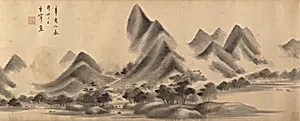
Landscape in the Style of Mi Fu
dated 1611 and 1612
Medium
Handscroll; ink on satin
Dimensions
10 1/5 x 86 1/4 in. (25.9 x 219.1 cm)
Classification
Paintings
Culture & Period
China · Ming dynasty (1368–1644)
Department
Asian Art
Museum
Metropolitan Museum of Art, New York, NY
Credit
Gift of Wan-go H. C. Weng, 1955
Accession Number
55.211.1
Rights
Public Domain
Tags
Art Historical Context
Created during the late Ming dynasty, this handscroll by Dong Qichang pays homage to the celebrated Song-dynasty master Mi Fu, whose distinctive “Mi dots” and atmospheric ink washes helped define an expressive approach to landscape painting. Dong, a leading scholar-official and theorist, frequently studied and reinterpreted earlier masters to articulate his own vision of literati painting, emphasizing personal expression over mere representation. The dual dates of 1611 and 1612 suggest the artist returned to the work over time, refining its layered mountains and misty valleys. Painted in ink on satin, the long, narrow format invites viewers to unroll the scroll gradually, experiencing the landscape as a journey through successive peaks and valleys. This intimate viewing practice reflects the deep cultural role of handscrolls in Chinese art, where contemplation unfolds at the viewer’s own pace. Dong’s restrained yet dynamic brushwork captures the essence of Mi Fu’s style while asserting his own late-Ming sensibility, reminding audiences that artistic tradition is continually reimagined by each generation.
About the Artist
Dong Qichang · 1555–1636
Dong Qichang (1555–1636), born in Huating in present-day Shanghai's Songjiang region, emerged from a scholarly yet impoverished family as the son of a local school teacher. A precocious child, he passed the prefectural civil service examination at age twelve, securing entry to a government school, and later sat for the imperial exams, placing second at seventeen to his cousin due to inferior calli...