
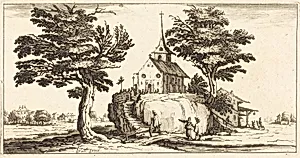
Landscape
in or after 1635
Medium
etching on laid paper
Dimensions
plate: 8.3 × 5.7 cm (3 1/4 × 2 1/4 in.) sheet (irreg.): 11 × 19.4 cm (4 5/16 × 7 5/8 in.)
Classification
Department
CG-E
Museum
National Gallery of Art, Washington, D.C.
Credit
R.L. Baumfeld Collection
Accession Number
1969.15.146
Rights
Public Domain
Art Historical Context
This delicate etching, titled *Landscape* and created in or after 1635, pays homage to the masterful style of Jacques Callot1592–1635), a pioneering French printmaker renowned for his intricate small-scale works. Callot, often called the father of modern etching, revolutionized the technique by using fine, acid-resistant grounds on metal plates to produce exceptionally detailed lines, capturing atmospheric depth and bustling scenes in miniature formats. Produced "after" Callot—likely by a contemporary follower or later copyist—this print exemplifies his influence on landscape etching during the Baroque era, when such intimate views evoked the grandeur of nature amid Europe's turbulent Thirty Years' War. Measuring just 8.3 × 5.7 cm on the plate (laid paper sheet slightly larger), the artwork invites close inspection, revealing Callot's signature precision in rendering foliage, distant hills, and winding paths. Etchings like this were affordable multiples, democratizing art for collectors beyond nobility, and laid paper's textured surface enhanced the ink's subtle tonalities. Part of the National Gallery of Art's R.L. Baumfeld Collection (Department CG-E), it highlights the enduring appeal of 17th-century printmaking as both technical innovation and poetic escape.
About the Artist
after Jacques Callot
**Jacques Callot (c. 1592–1635)**, the master whose designs inspired the works attributed "after Jacques Callot," was a pioneering French Baroque printmaker and draftsman born in Nancy, capital of the independent Duchy of Lorraine (now northeastern France). From a noble family—his father served as master of ceremonies and herald-at-arms to the Duke of Lorraine—young Callot was apprenticed to a gol...