
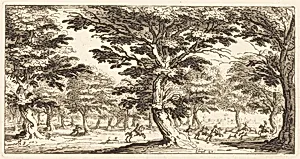
Landscape
in or after 1635
Medium
etching on laid paper
Dimensions
plate: 8.3 × 15.9 cm (3 1/4 × 6 1/4 in.) sheet: 11.2 × 19.2 cm (4 7/16 × 7 9/16 in.)
Classification
Department
CG-E
Museum
National Gallery of Art, Washington, D.C.
Credit
R.L. Baumfeld Collection
Accession Number
1969.15.149
Rights
Public Domain
Art Historical Context
This delicate etching, titled *Landscape* and created in or after 1635 after the renowned French artist Jacques Callot, captures intricate beauty of nature in a compact plate measuring just 8.3 × 15.9 cm. Callot (1592–1635), a virtuoso of printmaking during the Baroque era, was celebrated for his masterful etchings that blended detailed landscapes with dramatic scenes of war and daily life. Working in the manner of this influential artist, the anonymous printmaker evokes Callot's signature style: fine, wiry lines that render foliage, hills, and distant architecture with astonishing precision on laid paper, a textured support ideal for capturing the subtle tones of early modern prints. Etching, the medium here, allowed artists like Callot to achieve unprecedented detail through acid-bitten lines on a metal plate, revolutionizing reproductive art and enabling wide dissemination of images. Produced shortly after Callot's death amid the turmoil of the Thirty Years' War, this work reflects the era's fascination with pastoral escapes amid conflict. Housed in the National Gallery of Art's R.L. Baumfeld Collection (Department CG-E), it exemplifies the technical innovation and poetic sensibility of 17th-century European printmaking, inviting visitors to appreciate how small-scale works carried profound artistic weight.
About the Artist
after Jacques Callot
**Jacques Callot (c. 1592–1635)**, the master whose designs inspired the works attributed "after Jacques Callot," was a pioneering French Baroque printmaker and draftsman born in Nancy, capital of the independent Duchy of Lorraine (now northeastern France). From a noble family—his father served as master of ceremonies and herald-at-arms to the Duke of Lorraine—young Callot was apprenticed to a gol...