
Landscape
in or after 1635
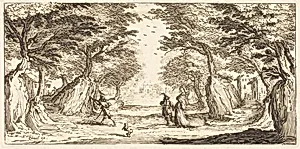
Medium
etching on laid paper
Dimensions
plate: 8.1 × 6.4 cm (3 3/16 × 2 1/2 in.) sheet (irreg.): 11.5 × 20 cm (4 1/2 × 7 7/8 in.)
Classification
Department
CG-E
Museum
National Gallery of Art, Washington, D.C.
Credit
R.L. Baumfeld Collection
Accession Number
1969.15.150
Rights
Public Domain
Art Historical Context
This delicate etching, titled *Landscape* and created after the masterful French printmaker Jacques Callot in or after 1635, captures the intricate beauty of 17th-century landscape art on a remarkably small scale. Measuring just 8.1 × 6.4 cm on the plate, it exemplifies the precision possible in printmaking during the Baroque era, when artists like Callot revolutionized etching techniques to produce highly detailed images from metal plates etched with acid. Callot (1592–1635), renowned for his vivid depictions of landscapes, festivals, and war scenes, influenced generations with his fine-line style and innovative use of multiple etching states for tonal depth. As a work "after" Callot, this piece likely draws from his pastoral visions, reflecting the period's fascination with nature amid Europe's turbulent Thirty Years' War. Printed on laid paper—a common support for the time that reveals its woven texture under light—it highlights etching's role in disseminating affordable art beyond elite patrons. Housed in the National Gallery of Art's Prints department as part of the R.L. Baumfeld Collection (CG-E), this tiny gem invites close inspection, revealing the technical virtuosity that made Callot a cornerstone of European graphic arts. A testament to enduring craftsmanship, it bridges intimate scale with expansive artistic legacy.
About the Artist
after Jacques Callot
**Jacques Callot (c. 1592–1635)**, the master whose designs inspired the works attributed "after Jacques Callot," was a pioneering French Baroque printmaker and draftsman born in Nancy, capital of the independent Duchy of Lorraine (now northeastern France). From a noble family—his father served as master of ceremonies and herald-at-arms to the Duke of Lorraine—young Callot was apprenticed to a gol...