
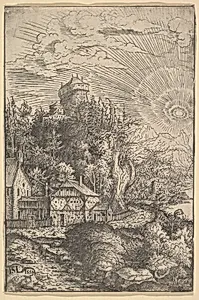
Landscape with a Castle Perched on a Rock
1553
Medium
Etching
Dimensions
Sheet: 6 5/8 x 4 7/16 in. (16.8 x 11.2 cm)
Classification
Prints
Department
Drawings and Prints
Museum
Metropolitan Museum of Art, New York, NY
Credit
Rogers Fund, 1919
Accession Number
19.74.12
Rights
Public Domain
Tags
Art Historical Context
In the mid-16th century, printmaker Hanns Lautensack captured the dramatic interplay of nature and architecture in *Landscape with a Castle Per on a Rock* (1553), a delicate etching measuring just 6 5/8 x 4 7/16 inches. From his base in Nuremberg, Lautens contributed to the Renaissance fascination with detailed landscapes, blending real and imagined elements in works that evoke the rugged beauty of the German countryside. This print exemplifies the era's growing interest in topography and fortified structures, reflecting both defensive architecture and the Romantic ideal of man-made wonders defying precarious natural formations. Etching, Lautensack's favored medium, allowed for intricate lines and tonal subtleties through acid-bitten plates—a technique gaining traction in Northern Europe for its spontaneity compared to engraving. Here, fine cross-hatching builds depth, with the castle's jagged silhouette towering atop a sheer rock face amid swirling mists and foliage. Acquired by The Metropolitan Museum of Art via the Rogers Fund in 1919, this small-scale marvel highlights printmaking's role in democratizing art, making vivid vistas accessible beyond elite patrons. Visitors will appreciate how Lautensack's vision bridges Gothic fantasy and emerging realism, offering a window into 16th-century Europe's evolving appreciation for landscape as subject unto itself.
About the Artist
Hanns Lautensack · 1515–1566
Hanns Lautensack, born in 1524 in Bamberg, Germany, was the son of Paul Lautensack, a noted painter and organist. Alongside his brother Heinrich, a goldsmith, the family relocated to Nuremberg in 1527, where Hanns immersed himself in the vibrant artistic milieu of the city. There, he likely apprenticed with a goldsmith, honing skills in fine metalwork that informed his precise etching technique, t...