
Landscape with Alpheus and Arethusa
1601 to 1650
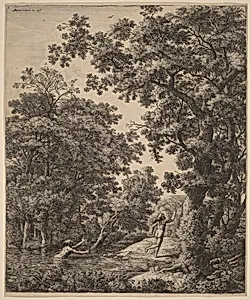
Medium
etching
Classification
Department
CG-E
Museum
National Gallery of Art, Washington, D.C.
Credit
Ailsa Mellon Bruce Fund
Accession Number
1980.76.1
Rights
Public Domain
Art Historical Context
In the serene *Landscape with Alpheus and Arethusa Dutch artist Anthonie Waterlooc. 1609–1690) masterfully blends classical mythology with the naturalistic landscapes of the Dutch Golden Age. Created as an etching between 160 and 1650, this print draws from Ovid's *Metamorphoses*, depicting the river god Alpheus in pursuit of the nymph Arethusa, who flees through a lush, atmospheric woodland. Waterloo, a specialist in prints, captures the drama of the myth amid towering trees and winding paths, evoking both ancient lore and the era's fascination with nature's sublime beauty. Etching, Waterloo's preferred medium, allowed for intricate line work and subtle tonal gradations, mimicking the effects of drawing on metal plates with acid. This technique was revolutionary in the 17th century, enabling artists like Waterloo—influenced by masters such as Rembrandt—to produce affordable yet detailed multiples for collectors. His style emphasizes light filtering through foliage and expansive vistas, contributing to the evolution of landscape as a respected genre beyond mere background scenery. Acquired through the Ailsa Mellon Bruce Fund and housed in the National Gallery of Art's Prints department (CG-E), this work exemplifies the technical innovation and cultural synthesis of Dutch printmaking, inviting visitors to ponder the timeless interplay of human pursuit and untamed wilderness.
About the Artist
Anthonie Waterloo · 1609–1690
Anthonie Waterloo (1609–1690) was a prominent Dutch Golden Age landscape artist, born on May 6 in Lille, then part of the Spanish Netherlands. Little is known of his early life beyond his mother, Magdalena Vaillant, who joined Amsterdam's Walloon Church in 1621, with Waterloo following in 1630; no records exist of formal training, and he was likely self-taught. Registered as a painter in Amsterdam...