
Landscape with Birch Trees (Le paysage aux bouleaux)
1878
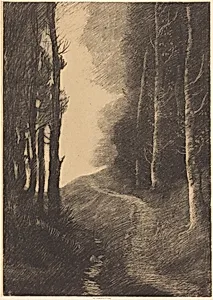
Medium
lithograph
Classification
Department
CG-E
Museum
National Gallery of Art, Washington, D.C.
Credit
Gift of George Matthew Adams in memory of his mother, Lydia Havens Adams
Accession Number
1956.14.15
Rights
Public Domain
Art Historical Context
Alphonse Legros's *Landscape with Birch Trees (Le paysage aux bouleaux, created in 1878, the serene beauty of nature through the versatile medium of lithography. This print, housed in the National Gallery of Art's Department of Prints (CG-E), showcases Legros's mastery of a technique invented in the late 18th century which allowed artists to draw directly on stone with greasy crayon, producing rich tonal gradations ideal for evoking the dappled light and slender forms of birch trees in a pastoral setting. A pivotal figure in 19th-century Realism, Legros (1837–1911)—born in France and later based in London—bridged continental and British art worlds, influencing students at the Slade School of Art. His landscapes reflect the Realist emphasis on everyday natural scenes, inspired by masters like Corot and Millet, amid the era's growing appreciation for plein-air observation. Lithography's reproducibility made such works accessible, democratizing fine art beyond oil paintings. Generously gifted to the National Gallery by George Matthew Adams in memory of his mother, Lydia Havens Adams, this piece exemplifies Legros's technical prowess and enduring appeal, inviting visitors to ponder the quiet poetry of the birch grove in an age of rapid industrialization.
About the Artist
Alphonse Legros · 1837–1911
Alphonse Legros (1837–1911) was born in Dijon, France, and trained in Paris at the drawing school of Horace Lecoq de Boisbaudran, whose unconventional teaching method — which emphasised memory drawing and acute observation over academic convention — would leave a lasting mark on Legros's practice. At Lecoq's school he formed friendships with Jules Dalou and Auguste Rodin that endured throughout hi...