
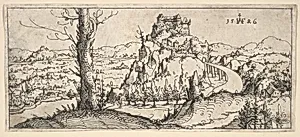
Landscape with High Rocks and Fortresses
Medium
Etching
Dimensions
Plate: 2 7/16 x 1 3/4 in. (6.2 x 4.5 cm) Sheet: 2 9/16 x 1 15/16 in. (6.5 x 5 cm)
Classification
Prints
Department
Drawings and Prints
Museum
Metropolitan Museum of Art, New York, NY
Credit
Harris Brisbane Dick Fund, 1926
Accession Number
26.72.110
Rights
Public Domain
Tags
Art Historical Context
Created in 1546 by the German artist Augustin Hirschvogel, *Landscape with High Rocks and Fortresses* is a delicate etching that captures the emerging Renaissance fascination with natural scenery and human-built structures. Measuring just over two inches in height, the print presents a compact yet evocative scene of towering rocks crowned by defensive fortifications, inviting viewers to explore the relationship between rugged terrain and architectural strength. Etching, a relatively new printmaking technique in the mid-sixteenth century, allowed Hirschvogel to achieve fine linear details and atmospheric effects on a small copper plate. This intimate scale suggests the work was intended for private collectors or inclusion in albums, where connoisseurs could appreciate its precise rendering of light, texture, and spatial depth. Today housed in the Metropolitan Museum of Art’s Department of Drawings and Prints, the etching reflects broader cultural interests of its time, when fortified landscapes served both practical and symbolic purposes amid shifting political boundaries. Its acquisition through the Harris Brisbane Dick Fund underscores the enduring appeal of early landscape prints in museum collections.
About the Artist
Augustin Hirschvogel · 1503–1553
Augustin Hirschvogel (1503–1553) was born in Nuremberg into a prominent family of stained-glass painters who dominated the city's glass workshops during the late 15th and early 16th centuries. The son of Veit Hirschvogel the Elder (1461–1525), Nuremberg's official glazier who executed designs after Albrecht Dürer and Hans von Kulmbach, Augustin trained as a glass painter in his father's workshop. ...